 Specialty Casters
Gate Casters
BBQ Pit & Smoker Casters
Keyed Drive Wheels
Drywall Cart Casters
Skid Wheels & Casters for RVs
Leveling Casters
Shopping Cart Wheels & Casters
Band Equipment Casters & Wheels
Low Profile Casters
Cart Wheels & Casters
Toolbox Caster Sets
Bakery Oven Rack Casters
Kitchen Prep Table Caster Sets
Wire Shelving Casters
Silent Glide Casters
Specialty Casters
Gate Casters
BBQ Pit & Smoker Casters
Keyed Drive Wheels
Drywall Cart Casters
Skid Wheels & Casters for RVs
Leveling Casters
Shopping Cart Wheels & Casters
Band Equipment Casters & Wheels
Low Profile Casters
Cart Wheels & Casters
Toolbox Caster Sets
Bakery Oven Rack Casters
Kitchen Prep Table Caster Sets
Wire Shelving Casters
Silent Glide Casters


Wheel = wheel diameter · capacity is per caster.


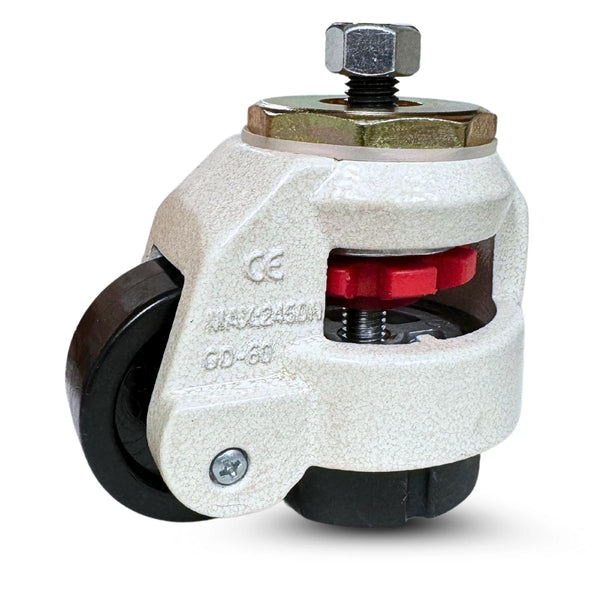
Leveling casters — also called retractable casters or pop-up casters — let machinery and equipment roll on wheels for relocation, then retract to firm leveling pads when the equipment must hold position. Press the lever down, wheel raises, pad takes the load. 1-3/4" to 3" wheel diameters, 400 to 6,600 lb per 4-pack, in plate and threaded stem mounts. Stocked at our Mansfield, TX facility.
Leveling casters combine a rolling caster with a retractable foot: roll the machine into place, then lower the pad to lift the wheel and lock the equipment dead level. Ratings are per 4-caster set, 110 to 6,600 lb, so divide by four for the per-corner figure. Choose by set capacity, thread size, and lever style (side lever, top adjust, or ratchet).
Compare every leveling caster (also called retractable, pop-up, or machine leveling caster) by wheel size, capacity, mount type, and lever mechanism. The capacity rating is per 4-caster SET — divide by 4 for per-caster load.
| Model | Wheel | Set Capacity | Mount | Best Application |
|---|---|---|---|---|
| TP-40 (S/F) | 1.75" x 13/16" | 440 to 880 lb | Stem or Plate | Light machinery, AV racks, lab equipment |
| TP-60 (S/F) | 2" x 0.88" | 600 to 2,400 lb | Stem or Plate | Industrial machines, prep tables, fixtures |
| TP-80 (S/F) | 2.5" x 1-3/16" | 4,400 lb | Stem or Plate | Heavy machinery, manufacturing equipment |
| TP-100 (S/F) | 2.85" - 3" x 1-1/4" | 6,400 to 6,600 lb | Stem or Plate | Extra-heavy machinery, mfg fixtures, equipment bases |
| Blickle 1-3/4" - 2" | Nylon | 400 to 550 lb each | Plate (integrated truck lock) | European OEM, lab carts, precision equipment |
| Blickle 2-31/64" - 3" | Nylon / Polyurethane | 660 to 1,650 lb each | Plate (integrated truck lock) | Industrial equipment, fixed-position machinery |
| Blickle 3-1/8" - 3-9/16" | Nylon Heavy-Duty | 1,320 to 4,400 lb each | Plate (integrated truck lock) | Heavy-duty industrial fixtures, manufacturing |
| QuickAdjust Ratchet | 2" Nylon | 2,400 lb set | Stem | Equipment that needs fine height adjustment |
The set rating divides 4 ways. A 2,400 lb set rating = 600 lb per caster maximum. Add 25 percent headroom over your fully-loaded equipment weight. A 1,200 lb machine on a 4-pack of TP-60 (2,400 lb rated) gives 100 percent headroom — correct. A 2,000 lb machine on the same TP-60 is too close to the rated max — step up to TP-80 (4,400 lb).
Stem-mount (S models) screws into threaded sockets already in the equipment base. The most common factory-equipment configuration. Plate-mount (F models) bolts to a flat surface and is required when the equipment doesn't have threaded sockets. Both retract the same way — the difference is purely how they attach.
TP-series retractable casters use a lever — press down to lower the wheel and roll, press up to retract and seat the pad. Blickle integrated truck lock casters are different: they use a heavy-duty foot-pedal that simultaneously raises the wheel AND locks the swivel mechanism. Blickle is the European-spec heavy-duty option used on precision and OEM equipment. Both are leveling casters, just different actuation styles.
Smaller wheels (1.75" TP-40) are easier to hide under low-clearance equipment but roll worse over uneven floors and bumps. Larger wheels (3" TP-100) clear thresholds and small debris but increase overall mount height. Pick the smallest wheel diameter that handles the worst floor you'll encounter.
Need help spec'ing a leveling caster system for a machine retrofit? Contact CasterHQ Engineering for application support.
Walkthrough of how retractable leveling casters work, when to use each type, and how to install. Covers the TP-series and Blickle integrated truck lock designs.
Prefer YouTube? Open the full video on the CasterHQ YouTube channel. Companion: Retractable Leveling Casters Full Tutorial.
CasterHQ stocks the complete TP-series retractable leveling caster line (TP-40 through TP-100 in both Stem and Plate configurations) plus the Blickle precision leveling caster line with integrated truck lock at our Mansfield, TX facility. 99 percent of orders — including 4-packs and single-piece replacements — ship same or next business day. Bulk fleet orders ship freight.
A leveling caster (also called a retractable caster or pop-up caster) combines a wheel and a fixed-position leveling pad in one unit. Press the lever down and the wheel lowers so the equipment rolls. Press the lever up and the wheel retracts, allowing the leveling pad to seat firmly on the floor and hold position. Used on machinery, prep tables, AV racks, and any equipment that must be relocated occasionally but holds exact position when working.
The terms are interchangeable. Both refer to the same product: a caster where the wheel can be raised and lowered manually, with a leveling pad taking the load when the wheel is raised. Some manufacturers prefer "retractable" (focuses on the wheel motion) and others prefer "leveling" (focuses on the held-position function). Same product, two names.
Per-caster capacity ranges from 110 lb (TP-40, 1.75" wheel) to 1,650 lb (TP-100 or large Blickle, 3" wheel). Four-pack set capacity ranges from 440 lb to 6,600 lb. The set rating divides 4 ways — always check the per-caster rating.
Check what your equipment has. If there are threaded sockets in the bottom of each equipment leg, you need stem-mount (S models). If there are flat surfaces where you can bolt a plate, you need plate-mount (F models). The performance is identical — just match the mount to your equipment.
Stem: thread the stem into the existing socket on each equipment leg, hand-tighten plus 1/4 turn with a wrench. Plate: bolt the mounting plate to the equipment using the provided hardware. With the wheel retracted, adjust each leveling pad to seat firmly on the floor. To move the equipment, press the lever on each caster to lower the wheel.
Most leveling casters do not include a wheel brake when the wheel is extended — they're meant for moving the equipment briefly, not parking it on wheels. Blickle integrated truck lock models combine the leveling function with a heavy-duty foot pedal lock for both wheel and swivel. Choose Blickle if you need wheels-extended locking.
The QuickAdjust Ratchet leveling caster uses a ratcheting screw mechanism instead of a simple lever. This lets you fine-tune the leveling pad height in small increments — useful when the floor isn't perfectly flat or you need precise equipment alignment to within 1/16 inch.
Most leveling casters in this catalog are designed for indoor industrial use. The lever mechanism and wheel bearings aren't sealed for outdoor exposure. For outdoor heavy equipment, contact us about industrial outdoor variants.
Yes — the leveling pad on each caster adjusts independently, so the equipment can sit level on slightly uneven floors. For severely uneven floors (1/2 inch or more variation), use the QuickAdjust Ratchet model for finer adjustment, or shim under the pads.
99 percent of orders ship same or next business day from our Mansfield, TX facility via FedEx Ground. Heavy 4-packs and freight orders ship via LTL with 24 to 48 hour transit. Cutoff is 2pm Central.