 Specialty Casters
Gate Casters
BBQ Pit & Smoker Casters
Keyed Drive Wheels
Drywall Cart Casters
Skid Wheels & Casters for RVs
Leveling Casters
Shopping Cart Wheels & Casters
Band Equipment Casters & Wheels
Low Profile Casters
Cart Wheels & Casters
Toolbox Caster Sets
Bakery Oven Rack Casters
Kitchen Prep Table Caster Sets
Wire Shelving Casters
Silent Glide Casters
Specialty Casters
Gate Casters
BBQ Pit & Smoker Casters
Keyed Drive Wheels
Drywall Cart Casters
Skid Wheels & Casters for RVs
Leveling Casters
Shopping Cart Wheels & Casters
Band Equipment Casters & Wheels
Low Profile Casters
Cart Wheels & Casters
Toolbox Caster Sets
Bakery Oven Rack Casters
Kitchen Prep Table Caster Sets
Wire Shelving Casters
Silent Glide Casters


Touring road cases, flight cases, ATA cases for pro audio and DJ rigs, theater production trunks, and the workhorse band-equipment carts that move gear from the truck to the stage all share the same hidden failure point: the casters. The 64 products on this page are the B2B replacement spec — pneumatic 8″ and 10″ for loading dock and outdoor venue work, solid thermo rubber for flat-free reliability, ATX (all-terrain) for parking lots and grass, and standard road-case dish casters for stackable case configurations. Used by Calzone, Anvil, Reliable Cases, and OEM case builders, plus DJ and band crews who refresh casters every 2-5 years.
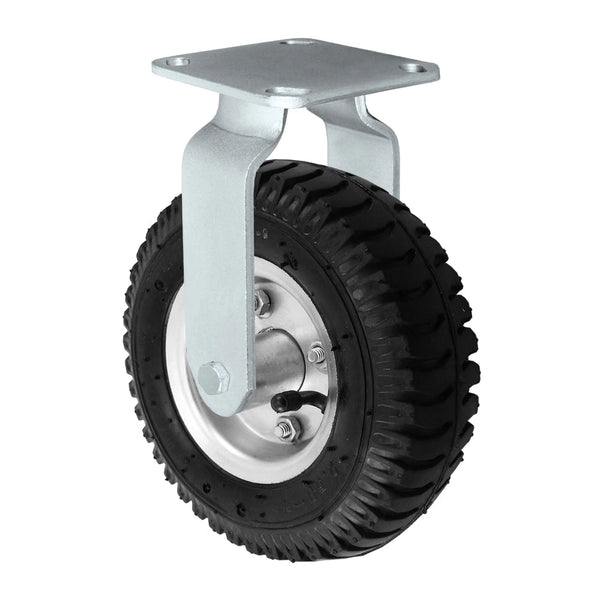
The cart and case ecosystem for a touring band or pro audio rig has one specific stress factor: continuous loading-dock-to-stage transitions across pavement, gravel, expansion joints, ramps, and stage decking. Standard polyurethane casters with hard tread transfer every floor seam straight up into the rack-mounted gear — over a tour cycle, that vibration loosens connectors, cracks PCB solder joints, and shifts rack-rail-mounted equipment in its sleeves. Pneumatic air-filled tires absorb that shock at the wheel before it travels up the case. The trade-off is the air-filled tire’s vulnerability to puncture from stage hardware, screws, and the occasional nail in a parking lot — which is why the solid thermo rubber flat-free variants exist as the “tour insurance” alternative.
Professional road cases stack on top of each other in truck packs and storage. The bottom corner of each case has a casters mounted into a recessed steel dish on the underside; the top corner of the case below has a matching dish that the caster wheel drops into — locking the upper case in place during transit. This stackable design is the spec for any case that ships in a semi-trailer, freight truck, or shipping container. Replacement casters for stackable cases must match the dish dimensions and the standard 3-1/2″ x 5-1/2″ or 4″ x 4-1/2″ case-corner plate pattern. Email info@casterhq.com with the case manufacturer and model number for fitment verification.
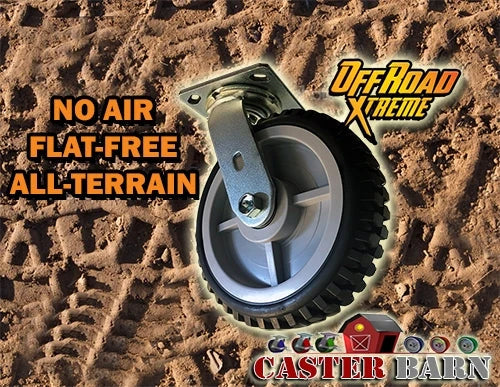
Tour managers and case builders increasingly spec solid thermo rubber flat-free wheels over pneumatic for three reasons. First, the flat-free wheel never goes flat on tour — eliminating the “case won’t roll’ phone call from a stagehand in a venue parking lot. Second, the solid wheel weighs slightly less than a pneumatic of the same size (no tire to inflate, no inner tube). Third, the solid thermo rubber absorbs shock nearly as well as pneumatic at the typical 5-10 mph rolling speeds in a venue or backstage environment — the pneumatic advantage really only shows up at higher speeds (gravel parking lot at speed, off-road handcart use). For 80% of touring applications, solid thermo rubber is the smarter spec.
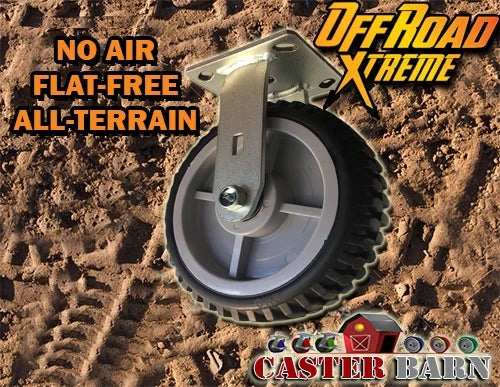
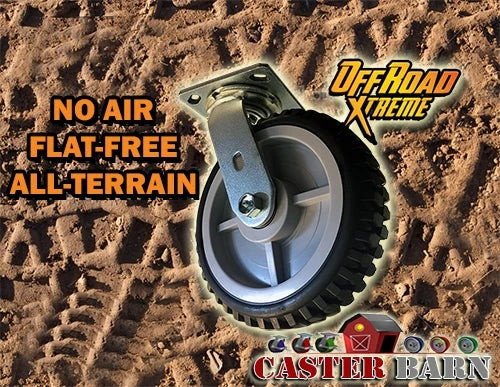
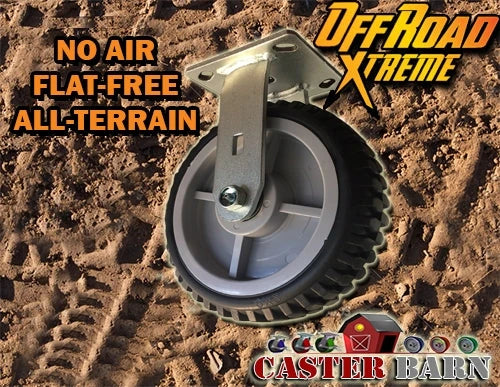
The ATX (all-terrain extreme) thermo rubber line uses a softer 80 Shore A durometer with a heavier tread pattern designed for outdoor venues, festival sites, and parking lots that haven’t been recently graded. Music festivals and outdoor amphitheaters are the heaviest users — cases roll across muddy backstage areas, gravel paths, grass, and uneven decking. ATX casters trade some rolling efficiency on smooth surfaces for the ability to actually move a 200-pound rack case through a field. If your touring schedule includes more than 2 outdoor festival dates per year, the ATX spec pays back fast.
2-5 years for active touring rigs. The bearing race wears faster than the wheel itself — pneumatic tires can last 5-7 years but the bearing inside the swivel raceway loosens after 18-30 months of weekly use. Replacement is straightforward on standard plate-mount casters: unbolt the worn unit, bolt up the new one, no case modification needed. Lockable brake casters take an extra minute per corner.
Two of four casters per case are conventionally lockable — the rear corners. We stock brake variants in both pneumatic and solid thermo rubber sizes. Best practice is to spec one of the two lockable brakes as a TOTAL-LOCK (locks wheel rotation AND swivel raceway) and the other as a standard wheel-lock-only brake. That combination keeps the case stationary during a stage hold and provides a quick-release secondary brake for stage cues.
Yes — the standard 4″ x 4-1/2″ top plate matches the predominant DIY case-building hardware (Penn-Elcom, Reliable Cases corner pieces, Adam Hall hardware). The stackable dish design requires a steel dish welded or riveted into the case corner; we don’t stock the dish itself but the casters are sized for the standard 3-1/2″ dish recess. For pure DIY builds without dishes, standard plate-mount casters work fine.
Total case weight (loaded with gear) divided by 4 casters, plus a 30% safety margin for loading-dock impact. A typical loaded rack case runs 150-250 lb; divide by 4 + 30% and you need at least 50-80 lb per caster. The 250-650 lb capacity range on this page covers everything from small effects cases up to heavy production trunks loaded with cable and stage rigging. Don’t under-spec — a caster failure during a load-out costs you a case repair AND a missed hit on the venue floor.
Yes. Pneumatic tires are non-marking and won’t damage typical stage decking or hardwood floors. The trade-off is rolling resistance — pneumatic rolls heavier than hard polyurethane on smooth indoor surfaces. For pure indoor use (rehearsal spaces, recording studios, broadcast facilities) standard solid polyurethane or thermo rubber is more efficient. Pneumatic is the right spec only if the case ALSO sees outdoor or rough-surface use during the same tour.
Cross-reference is supported — many Penn-Elcom and Adam Hall caster specs match products in our inventory at the dimensional level. Email info@casterhq.com with the existing caster part number or photograph the mount with a tape measure for scale, and we’ll match to the equivalent CasterHQ SKU. Some specialty road-case casters (the smallest dish-style under 3″ wheel) are not in our standard inventory but can be drop-shipped from the manufacturer.