 Specialty Casters
Gate Casters
BBQ Pit & Smoker Casters
Keyed Drive Wheels
Drywall Cart Casters
Skid Wheels & Casters for RVs
Leveling Casters
Shopping Cart Wheels & Casters
Band Equipment Casters & Wheels
Low Profile Casters
Cart Wheels & Casters
Toolbox Caster Sets
Bakery Oven Rack Casters
Kitchen Prep Table Caster Sets
Wire Shelving Casters
Silent Glide Casters
Specialty Casters
Gate Casters
BBQ Pit & Smoker Casters
Keyed Drive Wheels
Drywall Cart Casters
Skid Wheels & Casters for RVs
Leveling Casters
Shopping Cart Wheels & Casters
Band Equipment Casters & Wheels
Low Profile Casters
Cart Wheels & Casters
Toolbox Caster Sets
Bakery Oven Rack Casters
Kitchen Prep Table Caster Sets
Wire Shelving Casters
Silent Glide Casters


Under 350 lb per caster is the tier where buyers most often get it wrong — in both directions. Reach too low and you’ve bought a furniture caster that flat-spots under a loaded AV cart. Reach too high and you’ve paid industrial-caster money to move a 200 lb display rack. This tier is the calibrated middle: built for light equipment that still rolls every day, on finished floors, where quiet motion and non-marking treads matter as much as the load number.


Carpet and finished tile. Non-marking polyurethane or TPR. Quiet roll is the spec, not the load number.
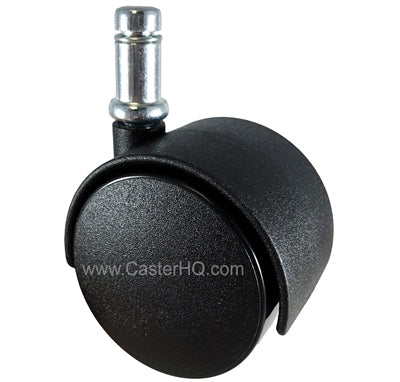
Visible to customers, so the caster has to look clean. Twin-wheel and architectural casters common here.
Non-marking, easy-clean, often total-lock brake. Polyurethane on polyolefin or thermoplastic rubber.
The cart works daily but the load stays light. Durability of the swivel matters more than the load rating.
The calculation is the same at every load tier: add the equipment weight to the load weight, multiply by a safety factor, divide by the number of casters. At this tier the safety factor is usually 1.3–1.5× because the floors are smooth and the equipment is rarely slammed or towed. So a 300 lb loaded AV cart on four casters needs roughly (300 × 1.4) ÷ 4 = about 105 lb per caster — comfortably inside this tier.
The tier ceiling matters more than the floor. If your math lands above 350 lb per caster, step up to the next tier — don’t buy at the top of this range and hope. The dynamic load rating (the weight the caster handles while rolling) is 60–80% of the static number on the spec sheet, and at this tier most carts roll more than they sit.