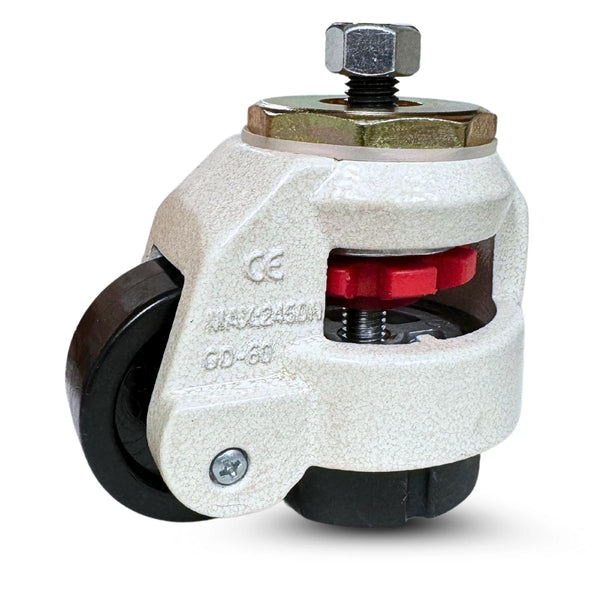
Up to 350 lbs
Up to 6,000 lbs
Up to 16,000 lbs
Up to 40,000 lbs
High-capacity loads
Shock absorbing
Corrosion resistant
Outdoor / rough terrain
OEM replacements
All measurements indicate the wheel diameter by the tread width.
The below capacity ranges indicate the working (dynamic) load that each caster will support. A safety factor should be included in your formula to determine your required load rating per caster.
W/(C-1)=R W is total weight needed to move. C is total number of casters required. R is ideal load rating, with safety factor built in. Divide the total load weight by one less caster than you will use to safely determine load rating.
Plate dimensions shown are overall mounting plate size.
When replacing existing casters, select the closest plate size and verify bolt-hole compatibility.
BHP = Bolt Hole Pattern, shown under each plate.
A 2″ wheel with a 7/8″ tread is the industrial light-duty spec — and it also overlaps with one of the most-searched office chair caster questions — so two different buyers end up on this page. If you’re replacing an office chair wheel, the stem is typically 7/16″ diameter and you want our Chair Casters — Office, Stool & Replacement collection instead. The 29 products on THIS page use the industrial 3/8″-16 threaded stem or the 1-1/4″ x 2-1/16″ top plate (some on a 1-7/8″ x 2-9/16″ plate) — for AV racks, prep stations, retail fixtures, hospitality carts, and light shop trucks. Five tread materials, 90-100 lb each, every common swivel-rigid-brake configuration. The TP-60 retractable leveling caster line shares the wheel size but is a separate workbench product, also stocked here.


Capacity stays consistent across tread materials at this size (90 to 100 lb each) because the wheel diameter is the constraint, not the rubber. Where the choice matters is floor compatibility, noise, and shock absorption.
| Tread | Capacity | Floor & Noise Profile | Where it fits |
|---|---|---|---|
| Hard Rubber | 100 lb | Quiet on concrete, faint marks on light tile | Warehouse, stockrooms, light shop carts |
| Soft Rubber | 90 lb | Whisper-quiet, non-marking, absorbs vibration | Hospitals, libraries, sensitive equipment |
| TPR (Thermoplastic Rubber) | 90 lb | Non-marking, oil-resistant, quiet | Food service, retail back-of-house, healthcare |
| Polyurethane | 100 lb | Non-marking, abrasion-resistant, low rolling resistance | Industrial floors with high cycle counts |
| Polyolefin (plastic) | 100 lb | Economy non-marking, chemical-resistant | Light retail, display fixtures, dry storage |
| Wheel-only replacements | 90–100 lb | Same as tread material above | When the existing caster body is still good |
Worn casters often look the same as the spec sheet but are out of tolerance. Pull a GOOD caster from the opposite corner of the equipment and measure that one — not the worn one. Diameter is outside-edge to outside-edge of the tread; width is face-to-face of the hub. 0.875″ reads as 7/8″. If you measure 1.000″, shop our 2″ x 1″ collection instead.
Top-plate version on this page uses 1-1/4″ x 2-1/16″ (most common) or 1-7/8″ x 2-9/16″ with 4 bolt holes. Threaded stem version uses 3/8″-16 thread at 1″ or 1-1/2″ long. If your equipment uses a 7/16″ diameter stem, you’re looking at an office chair caster — jump over to our Chair Casters collection for the right fitment.
Standard 4-caster cart pattern is 2 swivel front + 2 rigid rear for predictable straight-line tracking down aisles. All-swivel for tight maneuvering — common on hospital, AV, and prep station carts. Side-lock brake on at least one corner if the cart must stay parked when loaded.
Hard rubber works for warehouse, stockroom, and shop floors where slight marking under load doesn’t matter. Soft rubber or TPR for finished commercial floors. Polyurethane for longest service life under continuous use. Polyolefin if cost is the priority and the floor is dry indoor. The wheel-only option exists when the caster yoke and bearing are still in good shape and you just need fresh tread.
Different spec, but we have you covered. Office chair casters use a 7/16″ diameter stem at 7/8″ long — the “7/8” in “7/16 x 7/8” refers to STEM length, not wheel width. For office chair replacements head over to our Chair Casters — Office, Stool & Replacement collection (50 styles, fits Herman Miller, Steelcase, HON, Secretlab and the rest). The casters on THIS page use a 2″ wheel diameter with a 7/8″ wheel tread width, mounted on a 3/8″-16 industrial threaded stem or top plate — for AV racks, prep stations, retail fixtures, and light shop trucks. Two different specs, same SERP cluster.
AV racks and audio-visual rolling stands; small prep stations and food prep tables; hospitality service carts; retail display fixtures and merchandising racks; light shop trucks; medical and dental equipment carts; tool boxes with built-in mobility. The unifying spec is a compact 2-inch wheel that needs to fit under low equipment without raising deck height, with enough capacity (90-100 lb each) to carry four-caster loads of 360-400 lb total.
Two plate sizes are common on 2″ x 7/8″ casters. The 1-1/4″ x 2-1/16″ plate with 4 bolt holes is the most common modern spec. Older equipment sometimes uses a 1-7/8″ x 2-9/16″ plate — we stock both. Measure your existing mount with a caliper before ordering. The threaded stem version uses 3/8″-16 thread at 1″ or 1-1/2″ stem length.
Yes — the TP-60 retractable leveling caster series shares the 2″ x 7/8″ wheel dimension but is a workbench-grade product rated up to 2,400 lb each. The wheel retracts via a handwheel or ratchet handle so the cart sits on a leveling foot when parked. The capacity jump (100 lb to 2,400 lb) happens because the leveling foot carries the load when stationary, not the wheel. Specified for industrial workbenches, machinery bases, and stationary equipment that occasionally needs to roll.
Yes. We stock 2″ x 7/8″ wheel-only replacements in all five tread materials — hard rubber, soft rubber, TPR, polyurethane, and polyolefin. Standard hub bore is 1/4″. If the existing caster yoke, swivel raceway, and bearing are still in good shape, swapping just the wheel costs roughly 40% of a full caster and extends service life another 3-5 years on typical industrial duty.
Hard rubber is approximately 80A durometer — firmer tread, lower rolling resistance, slight floor marking under heavy load on light-colored finishes, full 100 lb rated. Soft rubber is approximately 60A durometer — softer tread, absorbs more vibration, non-marking on finished floors, rated slightly lower at 90 lb. Soft rubber is the spec for hospital, library, and any noise-sensitive application. Hard rubber is the standard for warehouse and shop carts where floor marking is acceptable.
Not cleanly. The 1/8″ tread-width difference is too tight to mix — a 7/8″ wheel rattles in a 1″ yoke and the wheel bearing fails prematurely from the lateral slop. A 1″ wheel binds in a 7/8″ yoke. To change wheel width you replace the entire caster, not just the wheel. The top plate dimensions are often identical between the two sizes so bolt holes line up — verify before ordering.
Stock 2″ x 7/8″ casters and wheel-only replacements ship same day from our Mansfield, Texas warehouse when ordered before 3 pm Central. UPS Ground reaches most US destinations in 2-3 business days. For replacement-match cross-reference questions or quantity quotes, call 844-439-4335 or email info@casterhq.com — a real engineer responds, not a chatbot.