 Specialty Casters
Gate Casters
BBQ Pit & Smoker Casters
Keyed Drive Wheels
Drywall Cart Casters
Skid Wheels & Casters for RVs
Leveling Casters
Shopping Cart Wheels & Casters
Band Equipment Casters & Wheels
Low Profile Casters
Cart Wheels & Casters
Toolbox Caster Sets
Bakery Oven Rack Casters
Kitchen Prep Table Caster Sets
Wire Shelving Casters
Silent Glide Casters
Specialty Casters
Gate Casters
BBQ Pit & Smoker Casters
Keyed Drive Wheels
Drywall Cart Casters
Skid Wheels & Casters for RVs
Leveling Casters
Shopping Cart Wheels & Casters
Band Equipment Casters & Wheels
Low Profile Casters
Cart Wheels & Casters
Toolbox Caster Sets
Bakery Oven Rack Casters
Kitchen Prep Table Caster Sets
Wire Shelving Casters
Silent Glide Casters


Capacity shown is per caster (per wheel for wheels).


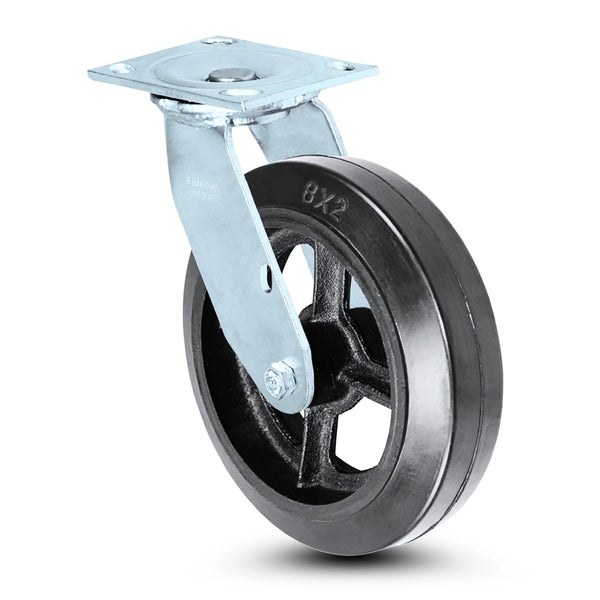
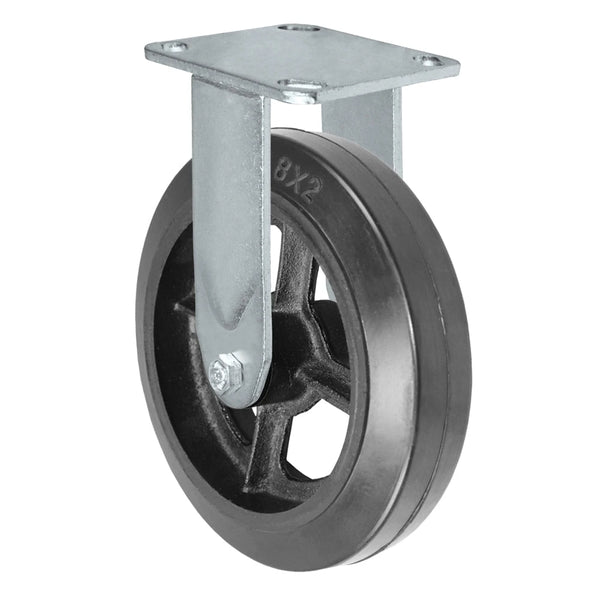
Mold-on rubber casters with rubber bonded to an iron hub, from CasterHQ and Hamilton. 4 to 8 x 2 in, rated 350 to 600 lb per caster, swivel and rigid.


| Size | CasterHQ swivel / rigid | Hamilton swivel / rigid |
|---|---|---|
| 4 x 2 in | 400 / 400 lb | Not stocked |
| 5 x 2 in | 450 / 400 lb | 350 / 350 lb |
| 6 x 2 in | 550 / 550 lb | 410 / 410 lb |
| 8 x 2 in | 600 / 600 lb | 500 / 500 lb |
Product fields [S1]. Hamilton models list -30 to 160°F [S2].
A solid rubber wheel is rubber all the way through. Mold-on rubber is bonded to an iron hub, so the hub carries the load and the tread will not spin on the core. OneMonroe lists mold-on rubber at about 70 Shore A and -30 to 160°F [S3], and Acorn's guide puts mold-on rubber in a 140 to 2,800 lb range across sizes [S4].
Wheels only: rubber wheels.
A caster whose rubber tread is molded and bonded directly to an iron hub, so the tread cannot slip on the core.
On this page, 350 to 600 lb per caster depending on size and maker.
Yes. The rubber tread is quieter than polyurethane, nylon or metal.
The CasterHQ models use a 4 x 4-1/2 in plate. Check the Hamilton listings for their plate size.