 Specialty Casters
Gate Casters
BBQ Pit & Smoker Casters
Keyed Drive Wheels
Drywall Cart Casters
Skid Wheels & Casters for RVs
Leveling Casters
Shopping Cart Wheels & Casters
Band Equipment Casters & Wheels
Low Profile Casters
Cart Wheels & Casters
Toolbox Caster Sets
Bakery Oven Rack Casters
Kitchen Prep Table Caster Sets
Wire Shelving Casters
Silent Glide Casters
Specialty Casters
Gate Casters
BBQ Pit & Smoker Casters
Keyed Drive Wheels
Drywall Cart Casters
Skid Wheels & Casters for RVs
Leveling Casters
Shopping Cart Wheels & Casters
Band Equipment Casters & Wheels
Low Profile Casters
Cart Wheels & Casters
Toolbox Caster Sets
Bakery Oven Rack Casters
Kitchen Prep Table Caster Sets
Wire Shelving Casters
Silent Glide Casters


Match the plate on your equipment: its outside size, or the bolt-hole spacing. How to measure →


Industrial plate casters — top-plate mount swivel and rigid casters for carts, machinery, equipment dollies, and industrial mobility. 2-3/8″ x 3-5/8″ light-duty plates through 12″ x 15-3/8″ super-heavy-duty plates. Capacities from 75 lb to 40,000 lb per caster. Steel, stainless, kingpinless, and shock-absorbing variants. 3,344 SKUs across 20 plate sizes. Stocked at our Mansfield, TX facility.
Managing plate casters across a fleet of carts or equipment? CasterHQ FleetTag maps your fleet to exact replacement SKUs and lets your team scan a QR tag to reorder the right caster in seconds, on Net 30/60 terms.
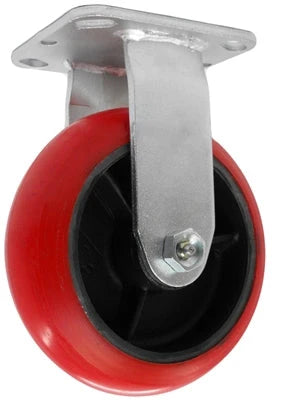
Plate casters are top-plate-mount casters that bolt to equipment through a flat four-hole plate, the most common mounting method in industrial material handling. CasterHQ stocks 3,344 plate casters from 75 lb light-duty to 40,000 lb mil-spec, in 20 plate sizes, steel or stainless, most shipping same day from Mansfield, TX.
Not sure which plate fits? Email info@casterhq.com or call 844-439-4335 for a fitment check.
Plate size correlates directly with capacity. Match plate to load and bolt-hole pattern on your existing equipment.
| Plate Size | Tier | Capacity Range | Wheel Sizes | Best For |
|---|---|---|---|---|
| 2-3/8″ x 3-5/8″ | Light Duty | 75 - 350 lb | 2″ - 5″ | Furniture dollies, tool boxes, light carts |
| 2-1/2″ x 3-5/8″ | Light-Medium | 100 - 500 lb | 3″ - 5″ | Service carts, food carts, light industrial |
| 3-1/8″ x 4-1/8″ | Medium | 300 - 800 lb | 3″ - 6″ | Shop carts, equipment dollies, medium loads |
| 4″ x 4-1/2″ | Medium-Heavy | 500 - 1,500 lb | 4″ - 8″ | Industrial carts, AGVs, manufacturing |
| 4-1/2″ x 6-1/4″ | Heavy Duty | 1,000 - 3,000 lb | 6″ - 10″ | Heavy industrial, towing, dock carts |
| 5-1/4″ x 7-1/4″ | Heavy Duty | 2,000 - 5,000 lb | 8″ - 12″ | Heavy machinery, foundry, steel mills |
| 6-1/4″ x 7-1/2″ | Super Heavy | 5,000 - 12,000 lb | 10″ - 14″ | Aircraft tugs, military, super-heavy industrial |
| 8-1/2″ x 8-1/2″ + | Mil-Spec | 12,000 - 40,000 lb | 12″ - 24″ | Mil-spec, aerospace ground support, custom |
If replacing casters on existing equipment, measure the bolt-hole spacing on the current mount, corner-to-corner across the diagonals. The plate size must match. The most common standard plates are 2-3/8″ x 3-5/8″ (light), 4″ x 4-1/2″ (medium-heavy, most popular), and 4-1/2″ x 6-1/4″ (heavy). Photograph the mount and email info@casterhq.com if you are unsure.
Total cart load divided by 4 casters, then add 30% for shock peaks on smooth indoor floors or 50% for outdoor and rough surfaces. Do not under-spec: a 1,000 lb load on 4 casters needs 325 lb per caster minimum.
Smooth concrete: 4-6″ works fine. Floor seams, light debris: 6-8″ minimum. Cracked concrete, outdoor, thresholds: 8-12″ required. Larger plate sizes accept larger wheels.
Standard 4-caster cart: 2 swivel front + 2 rigid rear for stable straight-line tracking. All-swivel: tight maneuvering, AGVs, dock work. Kingpinless swivel: shock-load applications where kingpin failure is the failure mode.
First-hand from our Mansfield, TX warehouse and engineering desk.
We carry the full plate caster catalog from every Tier 1 manufacturer, Hamilton, Albion, Faultless, Colson, and Caster Concepts, rather than a single private-label line, so plate size, capacity, and wheel material can be matched to the application instead of to whatever one brand stocks. All 20 plate sizes, from 2-3/8″ x 3-5/8″ light-duty through 12″ x 15-3/8″ mil-spec, are kept on the shelf here in Mansfield.
Before an order ships, our team cross-references the bolt-hole pattern and overall plate envelope against the equipment it is mounting to, the mismatch that causes most replacement failures. Send photos with the equipment make and model to info@casterhq.com and we verify fitment before you buy. Stock plate casters picked before 3pm CT ship the same day; super-heavy and mil-spec sizes are freight-quoted at order with lead time confirmed up front.
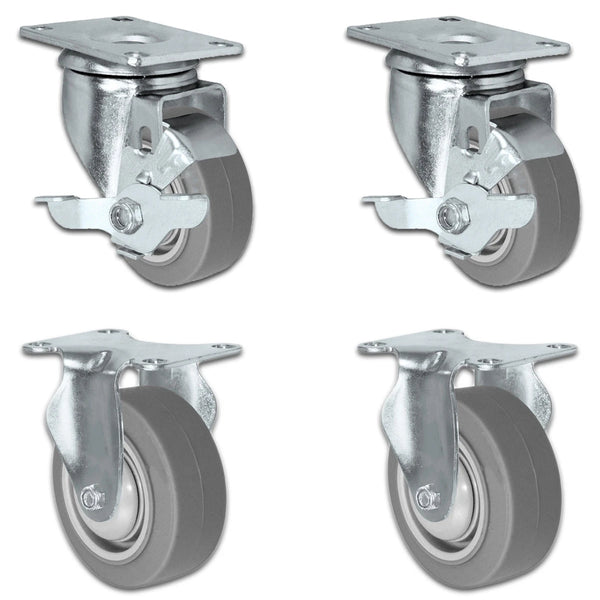
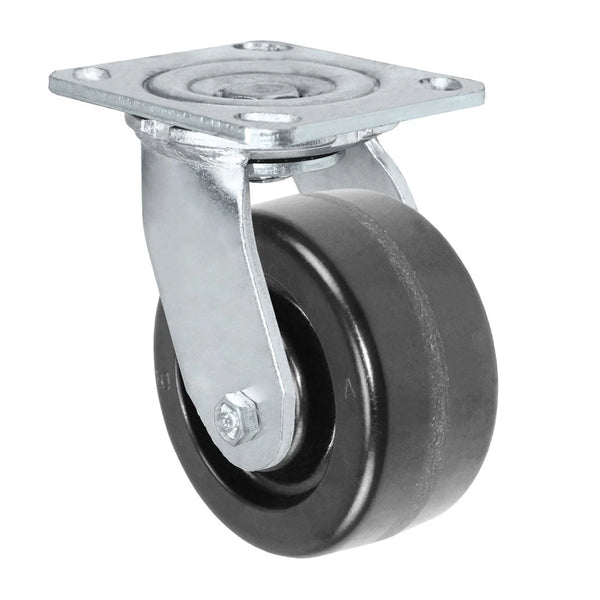
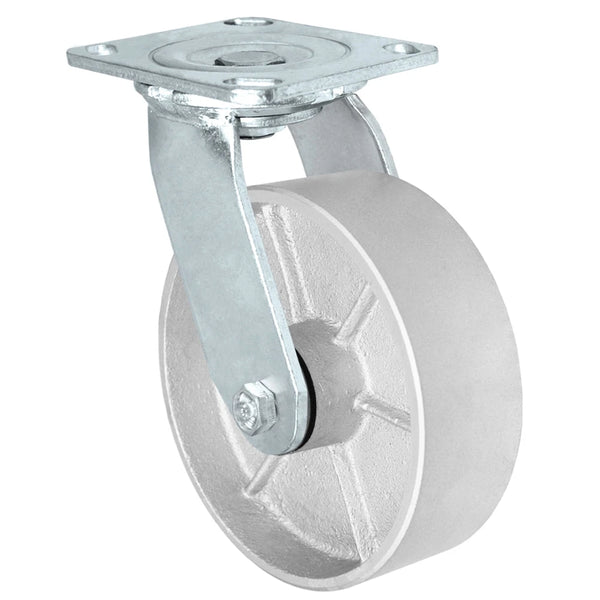
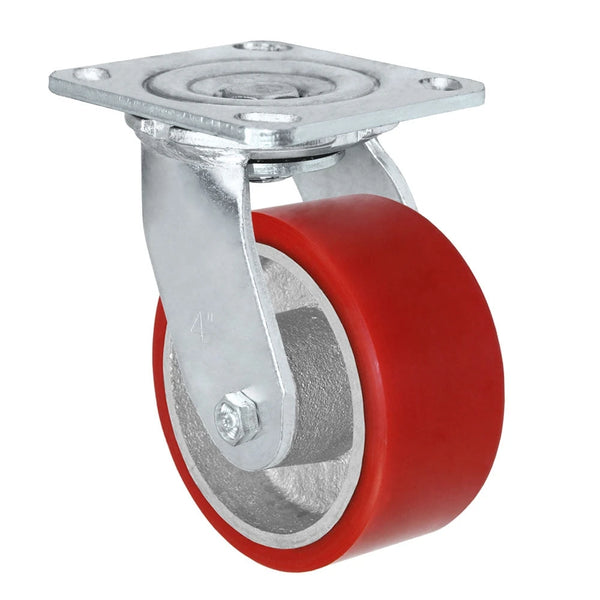
A caster that mounts to equipment via a flat top plate with 4 bolt holes. The top plate transfers load and rotation forces between the equipment and the caster. Plate casters are the most common mount style in industrial caster applications.
4″ x 4-1/2″ is the most-specified industrial plate size in North America, 1,788 of the 3,344 plate caster SKUs at CasterHQ use this plate. Capacity range: 500-1,500 lb per caster.
Measure the four bolt holes on your existing equipment mount, corner to corner across both diagonals. Both bolt pattern and plate dimensions must match for bolt-for-bolt replacement.
A kingpinless caster has no central kingpin in the swivel raceway. Kingpinless eliminates the most common caster failure mode, kingpin loosening or shearing under shock loads. Capacity is typically 1,000-12,000 lb per caster.
CasterHQ stocks Hamilton mil-spec plate casters up to 40,000 lb per caster. These use 12″ x 15-3/8″ super-heavy plates with 16-24″ wheels. Lead time on the largest sizes: 4-6 weeks.
Steel plate casters: zinc-plated finish for indoor industrial use, lower cost, full capacity range. Stainless plate casters: 304 or 316 stainless for wet, washdown, food, pharma, and corrosive environments.
Yes, welded plate casters use the top plate as a weld attachment surface. Weld-on requires steel plate (not stainless or aluminum). Specify weld-prep finish at order.
No, plate casters ship without bolts because bolt length depends on the thickness of the equipment frame. Use grade 5 zinc-plated steel bolts with washers and lock nuts.
Plate caster ratings on this page trace to published standards, not catalog optimism. Dynamic load ratings follow the ICWM performance standard for casters and wheels; wheel tread hardness is specified by durometer per ASTM D2240; and cart guidance aligns with OSHA 29 CFR 1910.176 materials-handling requirements. If a plate caster cannot show its test basis, we do not stock it.