 Specialty Casters
Gate Casters
BBQ Pit & Smoker Casters
Keyed Drive Wheels
Drywall Cart Casters
Skid Wheels & Casters for RVs
Leveling Casters
Shopping Cart Wheels & Casters
Band Equipment Casters & Wheels
Low Profile Casters
Cart Wheels & Casters
Toolbox Caster Sets
Bakery Oven Rack Casters
Kitchen Prep Table Caster Sets
Wire Shelving Casters
Silent Glide Casters


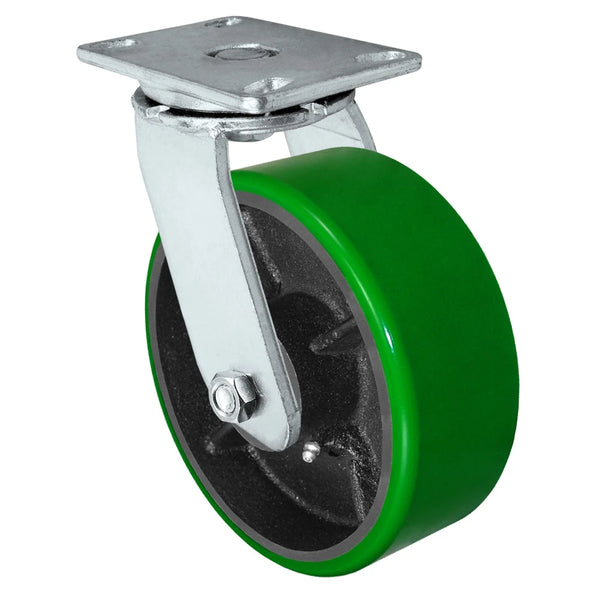
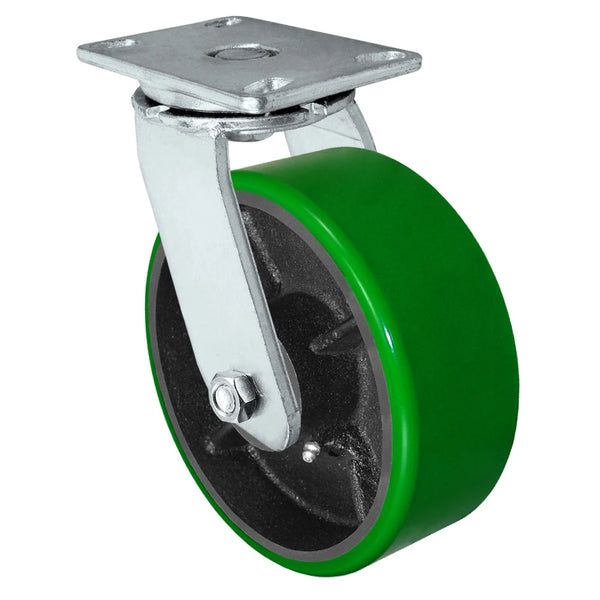
Heavy duty casters on this page are 24 plate-mount swivel and rigid casters with 6, 8, 10 and 12 inch wheels, all 3 inches wide and rated 2,000 to 2,500 lb per caster. Wheels are polyurethane on a steel or iron core, or ductile iron rated up to 800°F. Every model uses a 4-1/2 x 6-1/4 inch top plate, and most run on roller bearings.


Heavy duty casters carry loads where standard casters bend, flat-spot or wear out the swivel. This page is a short list of CasterHQ heavy duty plate casters: polyurethane on steel or iron wheels and ductile iron wheels, 6 to 12 inches across and 3 inches wide. For more sizes and higher ratings, see the full heavy duty casters range.
All 24 casters here are rated 2,000 to 2,500 lb each. For heavier loads or harder shock, step up to super duty or extreme duty casters.
Use this table before you filter the grid.
| Criterion | What to decide | Practical rule |
|---|---|---|
| Capacity per caster | Total equipment weight ÷ number of casters, then add headroom for dynamic load | Divide the loaded weight by three for a four-caster cart. A 6,000 lb loaded cart needs about 2,000 lb per caster, which fits this page; a 12,000 lb cart needs about 4,000 lb per caster and belongs in super duty. |
| Swivel construction | Kingpinless vs conventional kingpin | Above about 1,500 to 2,000 lb, or with shock from dock plates or constant swiveling, look at kingpinless casters. A standard kingpin swivel can work for lighter duty with little shock. Check each listing for swivel construction. |
| Heavy duty caster wheel material | Floor, marking, heat, and capacity tradeoffs | Polyurethane on a steel or iron core for concrete and coated floors. Ductile iron for heat, chips and rough floors; the ductile listings here are rated up to 800°F. |
| Diameter and tread width | Roll resistance vs overall height | Larger wheels (10 to 12") roll easier over debris and thresholds. Every wheel here is 3" wide, in 6, 8, 10 and 12" sizes. |
| Rig type | Swivel, rigid, or mixed set | Two swivel + two rigid is the default tracking cart set. All-swivel for staging; all-rigid for guided rails only. |
| Top plate / bolt pattern | Match existing mounting holes | Every caster here uses a 4-1/2" x 6-1/4" plate, most with a 2-7/16" x 4-15/16" bolt pattern, slotted. Confirm on the listing before ordering replacements. |
| Duty environment | Manual push vs tow / AGV speed; continuous park under load | Tell us the route speed if towing, since walk-speed casters wear early behind tuggers. Soft polyurethane can flat-spot under a load left parked; choose a harder tread when loads sit. |
Good starting points from this page when you already know the wheel size and tread.
Divide the loaded weight by three for a four-caster cart. Do not size only to the scale ticket if the route includes dock plates or impact.
Kingpinless: longer swivel life under heavy load and shock. Conventional: lower cost when duty is lighter and shock is controlled. Browse kingpinless casters when swivel wear is the problem.
Polyurethane on an iron or steel core for heavy industrial floors. Ductile iron for heat, chips and rough floors.
Confirm the plate and bolt hole centers on the listing. Plates get larger as ratings go up.
Need a set matched to an existing bolt pattern or tow speed? Contact CasterHQ with load, floor, and route details.
These 24 casters are from the CasterHQ heavy duty line. In-stock orders placed by noon CST ship the same day. For sizes outside this list, use the full heavy duty casters collection or contact us for a cross-reference.
Each caster on this page is rated 2,000 to 2,500 lb. Most 6 x 3 in polyurethane casters are 2,000 lb; the 8, 10 and 12 in polyurethane casters and the ductile iron casters are 2,500 lb.
Every caster here has a 4-1/2 x 6-1/4 in top plate. Most have bolt holes at 2-7/16 x 4-15/16 in, slotted so they also fit a 3-3/8 x 5-1/4 in pattern.
Polyurethane is quieter and easier on concrete and coated floors. Ductile iron handles chips, rough floors and heat; the ductile iron listings here are rated up to 800°F.
Wheels are 6, 8, 10 and 12 in, all 3 in wide. Overall height is 7-1/2 in on the 6 in casters, 10-1/8 in on 8 in, 11-1/2 in on 10 in and 13-1/2 in on 12 in.
No. Every listing on this page is a plain swivel or rigid caster. A common setup is two swivels at the steering end and two rigids at the other.
Divide the loaded weight by three rather than four, because one caster often carries little on an uneven floor. Four 2,500 lb casters from this page then suit about 7,500 lb.
Engineer Tip: 4 Heavy Duty Sizing Mistakes
Continue your build · related caster collections