 Specialty Casters
Gate Casters
BBQ Pit & Smoker Casters
Keyed Drive Wheels
Drywall Cart Casters
Skid Wheels & Casters for RVs
Leveling Casters
Shopping Cart Wheels & Casters
Band Equipment Casters & Wheels
Low Profile Casters
Cart Wheels & Casters
Toolbox Caster Sets
Bakery Oven Rack Casters
Kitchen Prep Table Caster Sets
Wire Shelving Casters
Silent Glide Casters
Specialty Casters
Gate Casters
BBQ Pit & Smoker Casters
Keyed Drive Wheels
Drywall Cart Casters
Skid Wheels & Casters for RVs
Leveling Casters
Shopping Cart Wheels & Casters
Band Equipment Casters & Wheels
Low Profile Casters
Cart Wheels & Casters
Toolbox Caster Sets
Bakery Oven Rack Casters
Kitchen Prep Table Caster Sets
Wire Shelving Casters
Silent Glide Casters


The 12 x 3 size occupies a specific gap in the wheel-diameter market. 10 x 5 and 10 x 4 give more capacity per caster at lower height. 12 x 4 and 12 x 5 give more capacity at the same height. The 12 x 3 wins when you want the rolling efficiency and curb-crossing ability of a 12-inch wheel, but the 3-inch tread width keeps total weight down and the price reasonable. Most often: platform trucks, lumber carts, refuse rolling, and commercial dumpster builds where the cart geometry rewards diameter over tread width.


| Build | Capacity | Where it fits |
|---|---|---|
| Mold-on rubber on cast iron | 1,125 lb | Platform trucks, commercial dumpsters, lumber carts |
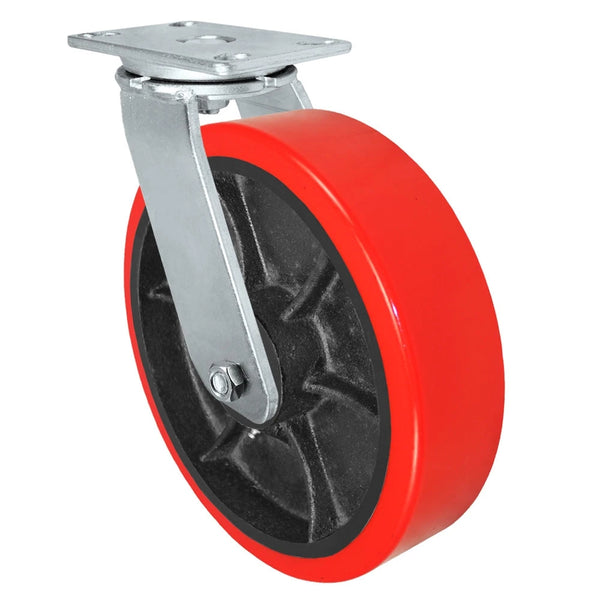
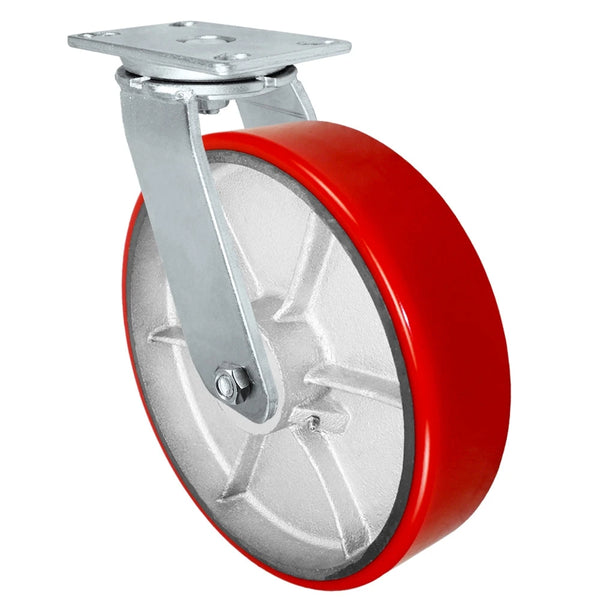
| Hamilton Duralast polyurethane on cast iron | 3,500 lb | Heavy industrial platform trucks, mold transport |
| Ultra high capacity polymer | 4,000-5,000 lb | Steel mill stage carts, foundry transfer rigs |
| Solid steel | 5,000-7,000 lb | Foundry, embedded rail, hot environments |
| Pneumatic (4-ply) | 800-1,200 lb | Outdoor staging, equipment dollies, rough pavement |
The whole point of going to 12″ over 10″ or 8″ is the rolling efficiency under load and the ability to clear floor irregularities. A 12″ wheel needs roughly 60% of the pushing force that an 8″ wheel needs to start the same load moving on the same floor. That math matters when the cart is hand-pushed and the load runs 2,000+ lb — the difference between a one-person move and a two-person move.
The 12″ diameter also clears expansion joints, dock plate gaps, and small obstacles (washers, bolts, small debris) without jamming. Anything smaller risks getting stuck at a seam edge when the wheel can’t bridge the gap.
If your load per caster exceeds 5,000 lb, jump to 12 x 4 or 12 x 5 — the wider tread adds capacity headroom that 12 x 3 can’t deliver. If vertical clearance is tight, drop to 8 x 2 or 10 x 2 with the height penalty you can afford. If the load sits static for 8+ hours under full weight, avoid mold-on rubber in this size (the rubber will flat-spot) and pick polyurethane or steel.