Up to 350 lbs
Up to 6,000 lbs
Up to 16,000 lbs
Up to 40,000 lbs
High-capacity loads
Shock absorbing
Corrosion resistant
Outdoor / rough terrain
OEM replacements
All measurements indicate the wheel diameter by the tread width.
The below capacity ranges indicate the working (dynamic) load that each caster will support. A safety factor should be included in your formula to determine your required load rating per caster.
W/(C-1)=R W is total weight needed to move. C is total number of casters required. R is ideal load rating, with safety factor built in. Divide the total load weight by one less caster than you will use to safely determine load rating.
Plate dimensions shown are overall mounting plate size.
When replacing existing casters, select the closest plate size and verify bolt-hole compatibility.
BHP = Bolt Hole Pattern, shown under each plate.
Most replacement-caster searches in the 3″ size class land on either Harbor Freight’s PVC swivel or a generic “3 inch caster” product page that doesn’t distinguish between the narrow 7/8″ tread and the wider 1-1/4″ tread. The two are not interchangeable. A 7/8″ wheel will rattle in a 1-1/4″ yoke and fail prematurely at the bearing. This page is the specific 3″ x 7/8″ spec — 16 styles in five tread materials, 90 to 100 lb capacity each, plate or threaded-stem mount. For wider 1-1/4″ tread casters in the same 3″ diameter, see our 3″ x 1-1/4″ collection.


Three inches is the practical floor for an industrial-quality caster. Below 3″ you’re into furniture-grade or institutional-grade hardware where the wheel diameter is too small to roll over typical floor seams, expansion joints, or stray debris without snagging. Above 3″ you’re paying for capacity (and raising the equipment deck) that most light-duty applications don’t need. The result is that 3″ with a 7/8″ tread became the industrial default for prep stations, AV racks, light shop trucks, retail-fixture mobility, and equipment where the cart sits at a normal table height of 30 to 36 inches.
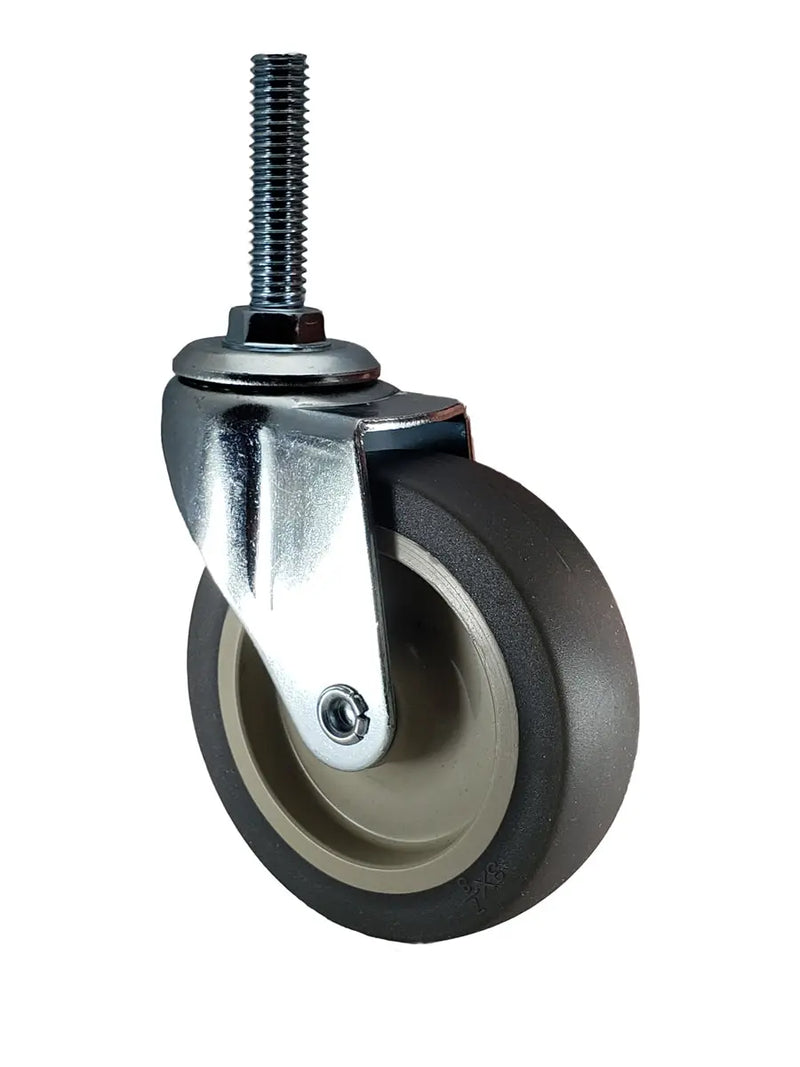
About two-thirds of the products on this page mount with a 1-1/4″ by 2-1/16″ top plate that bolts to the equipment frame through 4 holes. The remaining one-third use a 3/8″-16 threaded stem that screws into a tapped hole or a welded nut on the frame — available in 1″ or 1-1/2″ stem lengths. Existing equipment usually dictates which mount you need. The plate is more common on factory-built carts and AV racks; the stem is more common on shop-built equipment and threaded-frame furniture. If you’re replacing a worn caster, pull a good one off the opposite corner of the equipment and measure the mount before ordering — not the worn wheel itself.
The five tread options on this page (hard rubber, soft rubber, thermoplastic rubber, polyurethane, polyolefin) all hit the same capacity range of 90 to 100 lb because the wheel diameter is the constraint, not the rubber. Where the choice matters is floor compatibility, noise, and longevity. Hard rubber rolls quietly on smooth concrete and is the workhorse for shop and warehouse use, with the trade-off of faint floor marks under load on light-colored tile. Soft rubber drops the durometer to about 60A, runs whisper-quiet, absorbs vibration, and won’t mark finished commercial floors — that’s the hospital, library, and noise-sensitive office spec. Polyurethane has the lowest rolling resistance, the longest service life under continuous use, and is non-marking; it’s the spec when the cart will see daily use for years. Thermoplastic rubber bridges the gap between rubber and poly — non-marking, oil-resistant, common in food service and healthcare. Polyolefin is the economy non-marking option for dry indoor light-load applications.
The most common applications by volume are AV racks and mobile production carts, where the 3″ wheel keeps the deck low enough to fit under standard tables and the 7/8″ tread is narrow enough to not look industrial. Hospitality and food-service prep tables come next — the TPR or polyolefin tread keeps the floor clean and quiet. Retail back-of-house transport carts and merchandising fixtures land here when the cart moves between aisles. Healthcare equipment carts — especially the institutional furniture grade — spec this size with soft rubber for quiet. Light shop trucks and tool carts use the hard rubber or polyurethane for daily wear. The unifying spec is a four-caster cart total capacity of 360 to 400 lb across the four wheels, with the cart deck sitting 33 to 36 inches off the floor after the caster height is added.
The plate dimensions and bolt-hole pattern are often the same between the two tread widths, so the caster will bolt up. But the wheel itself is narrower in the yoke — the 7/8″ wheel rattles in a 1-1/4″ yoke, the bearing wears prematurely, and the swivel feels loose. Mixing them is a fitment compromise that costs you wheel life. Match wheel width to yoke width; replace the whole caster if you’re changing tread width.
Four casters at 100 lb each gives you 400 lb static cart capacity. Apply a 25-30% safety margin for shock loads on rough floors and you’re looking at 300 lb of usable cargo on a four-caster cart. If you need more, the next step up is the 3″ x 1-1/4″ collection with capacities running 150 to 350 lb per caster.
The TPR threaded-stem brake variant is the only brake configuration we stock at 3″ x 7/8″. Side-lock brake on the wheel rotation (not the swivel raceway). For combined wheel-and-swivel total-lock brakes, step up to a heavier-duty class — see Total Locking Casters where the larger plate sizes start at 4″ wheels and 350 lb capacity.
Yes. Five wheel-only replacements at 1/4″ bore in this exact 3″ x 7/8″ size class are stocked. Common when the caster yoke and swivel raceway are still tight but the rubber tread is worn through. Costs about 40% of a full caster replacement.
The Harbor Freight #66360 is a PVC tread on a zinc-plated steel yoke at 125 lb capacity — a retail-grade light-duty caster. The 16 products here are industrial-grade with five tread material choices, sealed bearings on the swivel raceway, and bolt-for-bolt OEM cross-reference. If you need a one-off light-duty caster for a home project, Harbor Freight is fine. For commercial replacement, fleet maintenance, or any application where caster failure means downtime, the spec-matched industrial variants on this page are the right pick.