 Specialty Casters
Gate Casters
BBQ Pit & Smoker Casters
Keyed Drive Wheels
Drywall Cart Casters
Skid Wheels & Casters for RVs
Leveling Casters
Shopping Cart Wheels & Casters
Band Equipment Casters & Wheels
Low Profile Casters
Cart Wheels & Casters
Toolbox Caster Sets
Bakery Oven Rack Casters
Kitchen Prep Table Caster Sets
Wire Shelving Casters
Silent Glide Casters
Specialty Casters
Gate Casters
BBQ Pit & Smoker Casters
Keyed Drive Wheels
Drywall Cart Casters
Skid Wheels & Casters for RVs
Leveling Casters
Shopping Cart Wheels & Casters
Band Equipment Casters & Wheels
Low Profile Casters
Cart Wheels & Casters
Toolbox Caster Sets
Bakery Oven Rack Casters
Kitchen Prep Table Caster Sets
Wire Shelving Casters
Silent Glide Casters


Rubber and polyurethane favor floor protection; phenolic and steel favor heavy capacity. Compare materials →


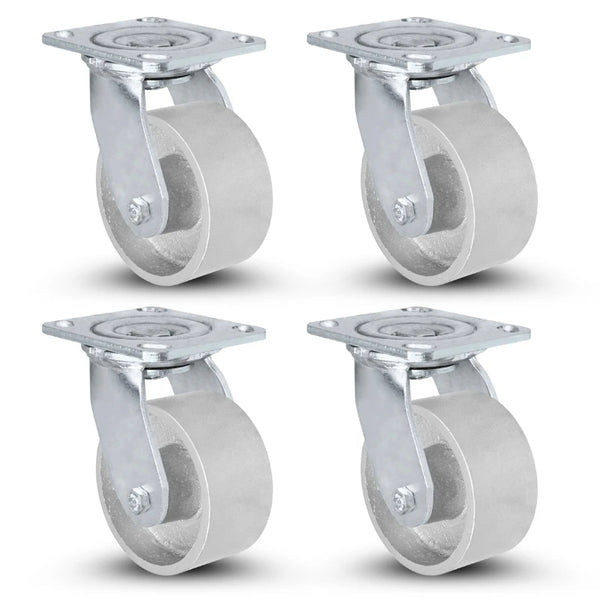
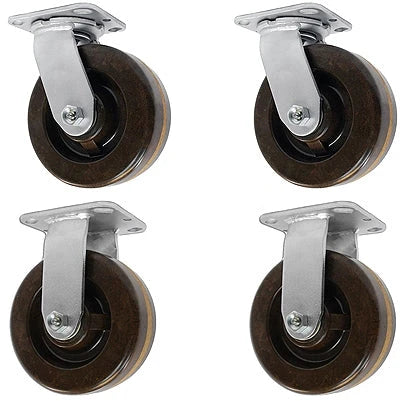
The 4″ x 2″ size is the workhorse light-medium industrial caster — smaller wheel diameter than 5″ or 6″ (lower deck height) but with the 2″ wide tread that distributes load across a wider contact patch than the narrower 4″ x 1″ or 4″ x 1-1/4″ variants. 1,095 styles spanning every standard material class: semi-steel 700 lb, polyurethane 800-1,000 lb, phenolic 800 lb, mold-on rubber 400-600 lb, plus specialty ATX off-road and total-lock brake variants. Standard 4″ x 4-1/2″ top plate matches medium-heavy industrial equipment.
The 4″ wheel diameter sits at the sweet spot between deck-height savings (small enough to keep cart decks low) and floor-seam crossing capability (large enough to roll over expansion joints and dock-plate transitions without snagging). Combined with the 2″ wide tread, the contact patch doubles vs. the narrower 4″ x 1″ or 4″ x 1-1/4″ variants — meaning higher capacity, lower wheel deflection, and longer service life under daily use. This size shows up on industrial assembly carts, AGV bases, food-service equipment, manufacturing transport carts, and any application where capacity is 200-1,000 lb per caster but the equipment deck height has to stay reasonable.
| Material | Capacity | Floor | Use |
|---|---|---|---|
| Mold-On Rubber | 400 lb | Quiet, non-marking | Hospital, library, noise-sensitive |
| TPR Industrial | 500-700 lb | Non-marking, oil-resistant | Food service, retail back-of-house |
| Semi-Steel | 700 lb | May mark light tile | Warehouse, shop carts, debris floors |
| Polyurethane on Polyolefin | 800-1,000 lb | Non-marking | Daily-use industrial, longest life |
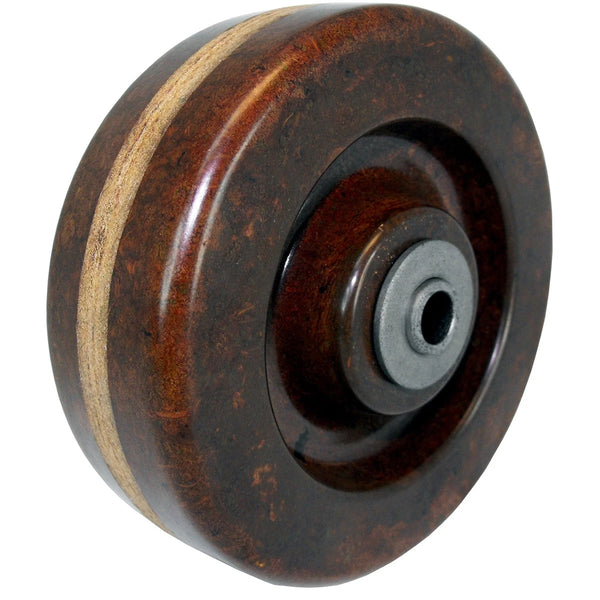
| Phenolic | 800 lb | Non-marking | Heat to 450°F (paint booth, bakery) |
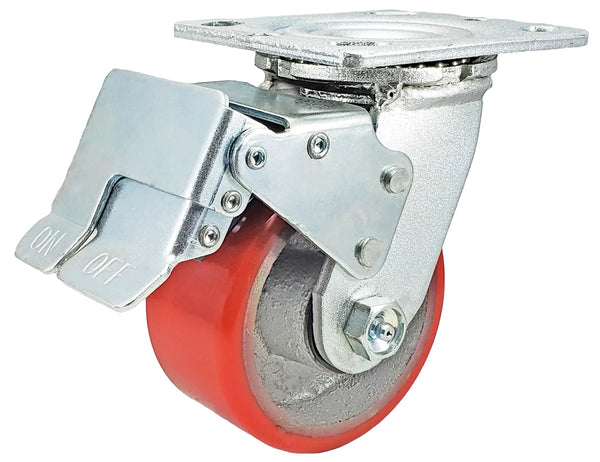
| Red Poly on Iron Total Lock | 4,000 lb (4-pack) | Non-marking | Heavy parked applications |
| ATX Off-Road | 275-500 lb | Aggressive tread | Outdoor, gravel, uneven surfaces |
Capacity and floor seam behavior. The 2″ tread distributes load across a wider contact patch — meaning higher per-caster capacity (700-1,000 lb vs. 200-500 lb at 1-1/4″) and less wheel deflection on rough floors. If your application needs more than 500 lb per caster, 4″ x 2″ is required.
5″ x 2″ raises the cart deck by 1/2″ per corner (1″ total) compared to 4″ x 2″. If deck height matters, stay at 4″. If you need higher capacity (5″ reaches 4,400 lb HD vs. 4,000 lb for the heaviest 4″ variant) or smoother floor-seam crossing, step up to 5″ x 2″.
Standard 4″ x 4-1/2″ medium-heavy industrial plate with 4 bolt holes — same as 5″ and 6″ sister sizes. Specialty configurations may use the smaller 3-1/8″ x 4-1/8″ plate for bakery and oven-rack applications.
Yes — the aggressive tread runs on smooth concrete without damaging floors. The trade-off is rolling resistance: ATX rolls heavier than polyurethane on flat floors because the tread pattern grips. Spec ATX only when the cart actually crosses outdoor or rough-surface terrain.
Yes — side-lock and total-lock brake stocked across all material classes. Total-lock variants reach 4,000 lb on the red poly on iron 4-pack set. Side-lock variants available individually in polyurethane and phenolic.