 Specialty Casters
Gate Casters
BBQ Pit & Smoker Casters
Keyed Drive Wheels
Drywall Cart Casters
Skid Wheels & Casters for RVs
Leveling Casters
Shopping Cart Wheels & Casters
Band Equipment Casters & Wheels
Low Profile Casters
Cart Wheels & Casters
Toolbox Caster Sets
Bakery Oven Rack Casters
Kitchen Prep Table Caster Sets
Wire Shelving Casters
Silent Glide Casters
Specialty Casters
Gate Casters
BBQ Pit & Smoker Casters
Keyed Drive Wheels
Drywall Cart Casters
Skid Wheels & Casters for RVs
Leveling Casters
Shopping Cart Wheels & Casters
Band Equipment Casters & Wheels
Low Profile Casters
Cart Wheels & Casters
Toolbox Caster Sets
Bakery Oven Rack Casters
Kitchen Prep Table Caster Sets
Wire Shelving Casters
Silent Glide Casters


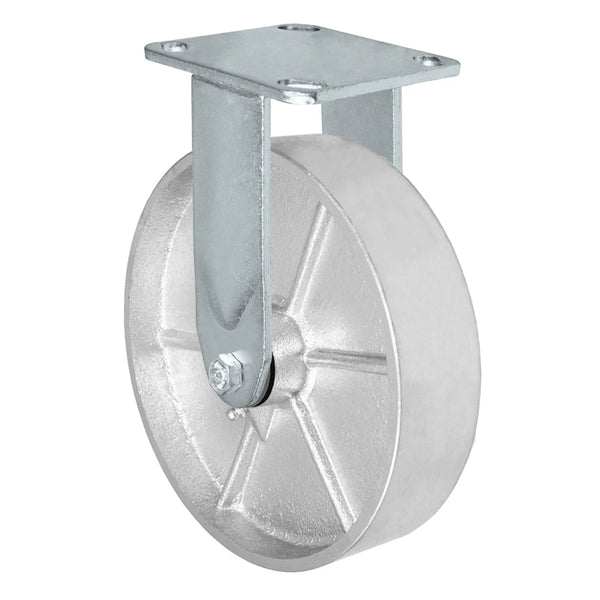
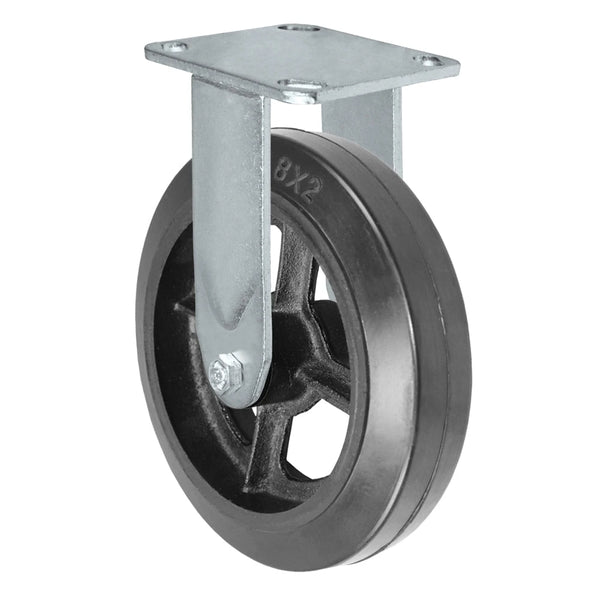
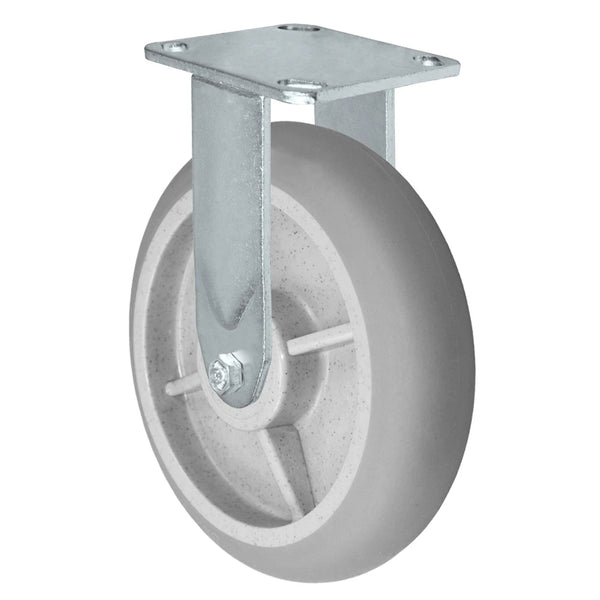
8″ is where industrial casters get serious. The bigger wheel diameter rolls over warehouse expansion joints and dock-plate transitions with significantly less push-force than 6″ or 5″ equivalents, and the 2″ tread distributes load across a wider contact patch. 1,301 styles span three distinct capacity tiers — from 275 lb flat-free thermo rubber for shock-absorbing outdoor work, through 1,250 lb semi-steel mid-range, up to 5,000+ lb red poly on cast iron for the heaviest fleet transport applications. Also includes the 700 lb TPR drywall cart caster spec and the 1,000 lb spring-loaded gate wheel.


Standard heavy industrial spec. 500-5,000 lb. The default for most warehouse and manufacturing cart applications. Deck height penalty is minimal (cart sits about 5.5″ off the floor with the yoke).
Best for: indoor cart applications where the floor is smooth concrete and the cart sees minimal threshold or expansion-joint crossing.
Heavy industrial with floor-seam advantage. 275-5,000+ lb. The 1″ diameter step up reduces push-force by 20-25% at the same load — meaning the same cart rolls easier across the same floor.
Best for: warehouse-to-dock applications, distribution centers with expansion joints every 20-30 ft, outdoor-pad-to-indoor transitions, drywall and construction-site rolling carts.
Three specialty variants in the 8″ x 2″ collection that don’t exist at smaller wheel sizes: the spring-loaded gate wheel (1,000 lb polyurethane with internal coil spring for impact absorption on sliding-gate applications and shock-load transport), the drywall cart caster (700 lb TPR with deep tread for jobsite gravel and debris on construction sites), and the flat-free solid thermo rubber off-road variant (275 lb for outdoor maintenance equipment where pneumatic punctures would be unacceptable).
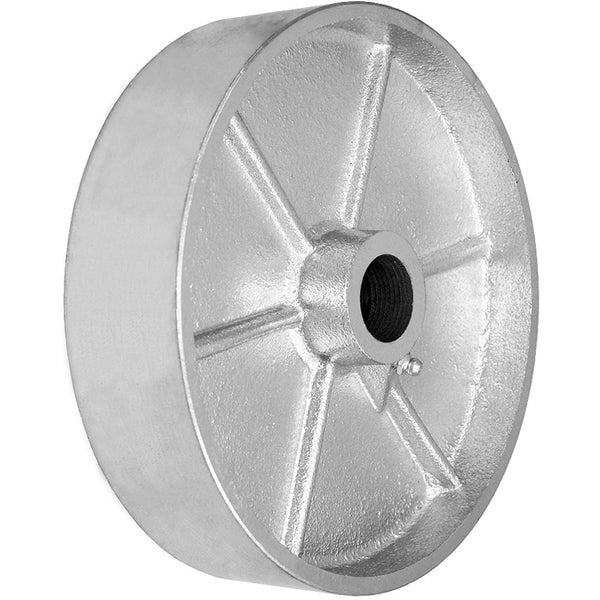
The 8″ x 2″ TPR Round Tread industrial replacement wheel is also unique — rated at 2,800 lb wheel-only with a 1/2″ bore. Used for kingpinless and HD caster yoke replacements where the wheel has worn through but the yoke is still tight. The round-tread profile (vs. flat tread) gives better point-contact on rough floors but reduces lateral stability — spec for application-specific use, not general industrial.
About 1″ per corner, so 2″ total cart deck height increase. For carts that must clear under dock plates, doorways, or shelving with tight overhead, this matters. For carts that don’t have height constraints, the deck-height penalty is worth the 20-25% push-force reduction and the floor-seam crossing advantage.
Construction-site rolling carts for moving drywall sheets, lumber, and tools across jobsite floors that have gravel, sawdust, screws, and uneven plywood transitions. The TPR (thermoplastic rubber) tread is softer than polyurethane (handles the impact of stepping over a 2x4) but tougher than mold-on rubber (resists puncture from screws and debris). 700 lb capacity per caster. Specified by general contractors and drywall installation crews.
Both. The spring-loaded design exists primarily for sliding-gate applications (the wheel absorbs impact when the gate hits the end-stop), but the same caster works on heavy carts where the cargo can’t tolerate the shock of crossing expansion joints. 1,000 lb capacity per caster. Used on industrial vehicle gates, security gates, and sensitive-cargo transport carts.
At conventional swivel construction, yes. Move to kingpinless construction at 8″ x 2″ and capacity reaches 8,000 lb per caster. Dual-wheel variants at 8″ reach 7,000-10,000+ lb per caster pair. See Kingpinless Casters and Dual Wheel Casters for the heaviest 8″ configurations.
Yes — 8″ phenolic is rated to 450°F continuous, same as the smaller 5″ and 6″ phenolic variants. The wheel size doesn’t change the material’s heat tolerance. For commercial bakery rack ovens with the standard 3-1/8″ x 4-1/8″ plate, the smaller 4″ or 5″ phenolic is the spec match. For larger production ovens with 4″ x 4-1/2″ plate mounting, 8″ phenolic is in scope. See Bakery & High-Temperature Casters for application context.
Predominantly 4″ x 4-1/2″ — same plate as 5″ and 6″ sizes. Heavy red-poly and kingpinless variants step up to the larger 4-1/2″ x 6-1/4″ plate. Specialty variants (drywall, gate) use 4″ x 4-1/2″.
Hamilton (Ergo-Glide XT and Duralast lines dominant at 8″), Albion, Faultless, Caster Concepts, Sirius HD all stocked. Cross-reference between brands: one business day response. Stock orders ship same day from Mansfield, TX. Larger red-poly and dual-wheel variants typically ship LTL freight on fleet quantities.
Buyer intent at this wheel size is highly B2B and specific — people search “8x2 caster” when they know exactly the spec they need. Position 8.7 reflects strong CTR potential. The 1,301 styles depth is unmatched among B2B caster distributors, and the specialty variants (drywall, spring-loaded, ATX) are search-volume drivers that smaller catalogs don’t carry.