 Specialty Casters
Gate Casters
BBQ Pit & Smoker Casters
Keyed Drive Wheels
Drywall Cart Casters
Skid Wheels & Casters for RVs
Leveling Casters
Shopping Cart Wheels & Casters
Band Equipment Casters & Wheels
Low Profile Casters
Cart Wheels & Casters
Toolbox Caster Sets
Bakery & High Temperature Casters
Kitchen Prep Table Caster Sets
Wire Shelving Casters
Silent Glide Casters
Specialty Casters
Gate Casters
BBQ Pit & Smoker Casters
Keyed Drive Wheels
Drywall Cart Casters
Skid Wheels & Casters for RVs
Leveling Casters
Shopping Cart Wheels & Casters
Band Equipment Casters & Wheels
Low Profile Casters
Cart Wheels & Casters
Toolbox Caster Sets
Bakery & High Temperature Casters
Kitchen Prep Table Caster Sets
Wire Shelving Casters
Silent Glide Casters


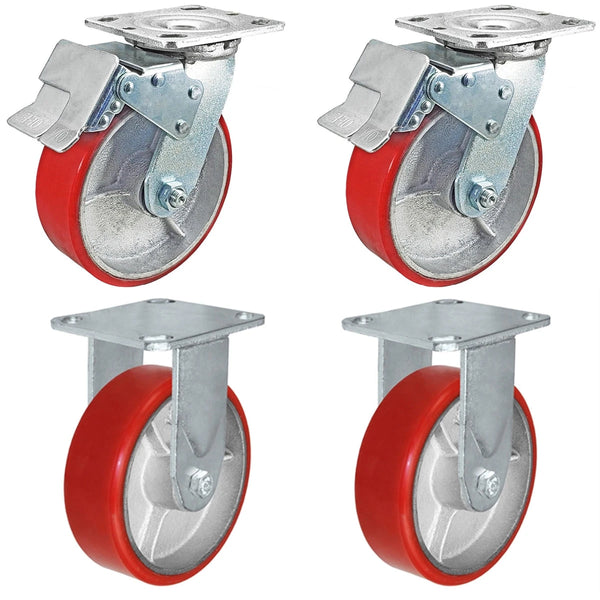
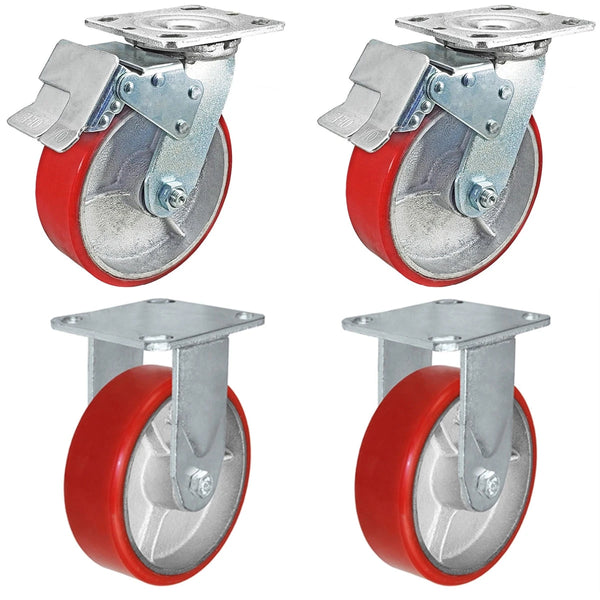
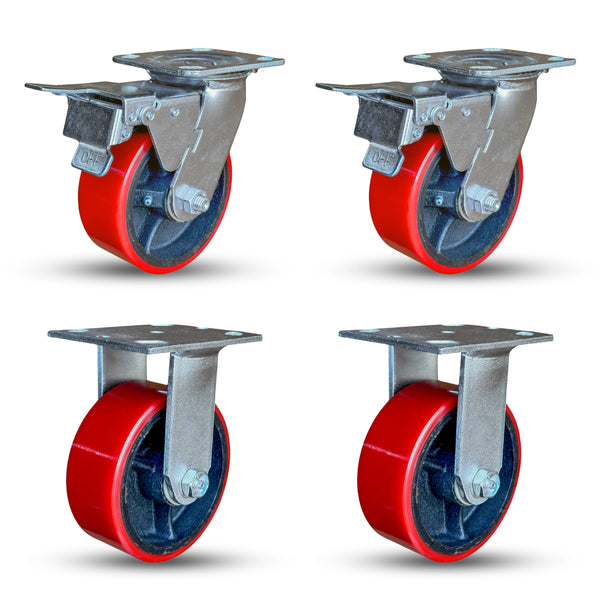
At 4,001-7,500 lb per caster you've left the heavy-duty tier and entered extra-heavy-duty. A four-caster set here carries 16,000-30,000 lb — full machine tools, loaded transfer carts, large die and mold equipment, powered tug-line trailers. The caster is no longer a part you bolt on and forget. It's a load-bearing structural component, and it gets specified like one.

The 2,001-4,000 lb tier is the heavy-duty threshold — the point where kingpinless construction and tapered roller bearings become standard. The 4,001-7,500 lb tier is where those features stop being adequate on their own and the whole caster has to be engineered as a system. Dual-row tapered roller bearings replace single-row. Forged steel wheel cores replace cast iron. Top plates get thicker and use more mounting bolts because the load distributing through the bolt holes has roughly doubled. And the swivel raceway gets larger in diameter to spread the cornering load across more contact area.
The practical signal you've crossed into this tier: the equipment can no longer be moved by hand. A four-caster set at 5,000 lb each carries 20,000 lb — well past what any crew can push or pull. Powered movement (a tugger or tow vehicle) becomes part of the equipment design, not an afterthought.
At this tier the floor becomes a real constraint, not a background assumption. A 7,500 lb load coming through an 8-inch wheel concentrates roughly 600-700 psi at the contact patch. Standard 4-inch industrial concrete is rated lower than that for sustained point loads — you'll get cracking along the wheel path within months. Three ways to solve it: go to a larger wheel diameter (10-12 inch) to spread the contact patch and drop the psi, use steel distribution plates along the travel path, or pour 6-inch reinforced concrete for permanent routes. Whichever you pick, it has to be decided before the equipment is built, because it changes the wheel diameter and therefore the deck height.
Machine tool bases — CNC mills, large lathes, presses that get repositioned for plant layout changes. Loaded transfer carts moving 15,000-25,000 lb of work-in-process between cells. Large die and mold carts in stamping and injection-molding plants, where the load is heavy and gets dropped onto the cart rather than lowered gently. Powered tug-line trailers in automotive and appliance plants. Aerospace tooling fixtures at the lower end of the aerospace range. And foundry and forge equipment that combines heavy load with heat and debris.
Polyurethane on a forged steel core is the default for indoor concrete — it carries the load, protects the floor, and rolls quieter than bare steel. Forged steel wheels handle the highest loads and the hottest environments but mark floors and transmit shock. Heat-dissipating polyurethane is the spec for sustained static loads where standard polyurethane would cold-flow (slowly deform under continuous weight). Match the wheel to the floor and the duty cycle, not to the lowest price — a wheel failure at 7,500 lb is a safety event.