 Specialty Casters
Gate Casters
BBQ Pit & Smoker Casters
Keyed Drive Wheels
Drywall Cart Casters
Skid Wheels & Casters for RVs
Leveling Casters
Shopping Cart Wheels & Casters
Band Equipment Casters & Wheels
Low Profile Casters
Cart Wheels & Casters
Toolbox Caster Sets
Bakery Oven Rack Casters
Kitchen Prep Table Caster Sets
Wire Shelving Casters
Silent Glide Casters
Specialty Casters
Gate Casters
BBQ Pit & Smoker Casters
Keyed Drive Wheels
Drywall Cart Casters
Skid Wheels & Casters for RVs
Leveling Casters
Shopping Cart Wheels & Casters
Band Equipment Casters & Wheels
Low Profile Casters
Cart Wheels & Casters
Toolbox Caster Sets
Bakery Oven Rack Casters
Kitchen Prep Table Caster Sets
Wire Shelving Casters
Silent Glide Casters


Custom made to order. All sales final.
Each Hamilton product is custom manufactured for your order (lead time is shown on each product page). Please confirm all specs before checkout, since made-to-order items aren't eligible for returns, exchanges or refunds. Need help? Call 844-439-4335 or email info@casterhq.com and we'll verify fit for you.
Wheel = wheel diameter · capacity is per caster.


Super-duty casters fill the bridge between heavy-duty (up to 8,000 lb) and extreme-duty (up to 40,000 lb). At single-caster loads of 10,000–23,000 lb, you’re moving aerospace fixtures, large machine tools, defense assembly platforms, and industrial transfer carts that need engineered construction without crossing into the floor-engineering-mandatory territory of the 20,000+ lb extreme tier.
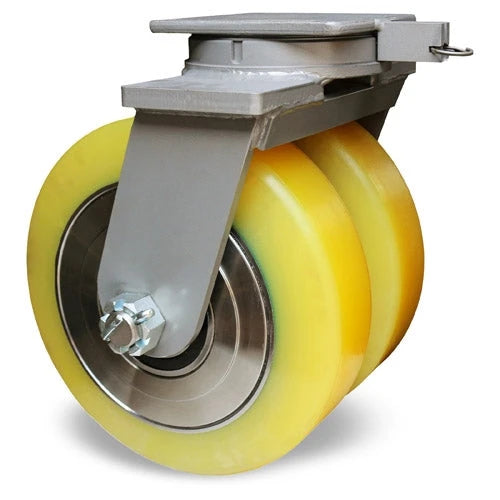
The yoke (the U-shaped frame that holds the wheel) is drop-forged from C-1045 medium-carbon steel rather than stamped or welded. Forging aligns the grain structure around the load path so the yoke doesn’t crack at stress points. Required at this capacity — stamped yokes fail at 8,000+ lb sustained.
The kingpin (the pin that lets the swivel rotate) is forged as part of the top plate, not pressed in as a separate piece. Integral construction means no shear plane between kingpin and plate — nothing to fail under cornering load. The 22″x8″ 99 Series caster from Caster Concepts uses this construction at 23,000 lb rated load.
The 85A durometer is softer than standard industrial polyurethane (95A). Soft poly absorbs floor debris (small bolts, weld slag, washers) without permanently deforming — the wheel rebounds after the debris clears. The thicker 1″ tread spreads point load and adds about 30% to service life vs the standard 1/2″ tread.
Most heavy-duty casters use tapered roller bearings for combined radial + thrust load. Super-duty straight roller bearings are used in pull-line applications where excessive thrust loading dominates — tuggers, tow chains, conveyor connections. Straight rollers handle pure thrust better at this scale.
| Load range | Yoke | Bearing | Tread |
|---|---|---|---|
| 10,000–13,000 lb | Drop-forged steel | Tapered roller (single row) | Polyurethane on iron |
| 13,000–17,000 lb | Drop-forged steel | Tapered roller (dual row) | HD poly or forged steel |
| 17,000–20,000 lb | Drop-forged C-1045 | Dual tapered + thrust | Forged steel or HD poly |
| 20,000–23,000 lb | Drop-forged C-1045 | Straight roller (pull-line) | 1″ thick 85A polyurethane |
Pick super-duty when you have any of these: (1) aerospace fixture transfer (engine cradles, wing fixtures, fuselage jigs), (2) machine tool repositioning (CNC, large mills, presses), (3) defense or military vehicle assembly platforms, (4) industrial battery transfer at automotive plants (forklift battery banks weigh 15,000–20,000 lb), (5) heavy industrial cleaning or maintenance carts that carry large equipment.
Skip super-duty if your load per caster is below 10,000 lb — heavy-duty casters in the 4,000–8,000 lb range will be cheaper and adequate. Step up to extreme-duty if your load per caster exceeds 23,000 lb.
Super-duty casters at 10,000–20,000 lb work on 6″ reinforced concrete with appropriate wheel diameters (12″+ wheels at the top end). At 20,000–23,000 lb you typically need steel distribution plates or embedded rail for sustained travel paths. Movement is usually powered (tugger or tow vehicle) above 12,000 lb per caster, although well-balanced platforms with low-rolling-resistance polyurethane can be hand-pushed at 4 x 10,000 lb if the floor and gradient are favorable.
Engineer Tip: 4 Super-Duty Rules We Don't Bend
Based on CasterHQ engineering field data across super-duty and towline installations.
No super-duty caster leaves Mansfield without an engineering review — load path, floor, speed, and duty cycle, on every RFQ. Ratings trace to the ICWM performance standard, and materials-handling guidance aligns with OSHA 29 CFR 1910.176. At this load class we would rather lose a day asking questions than ship a rig that gets someone hurt.
Continue your build · related caster collections