 Specialty Casters
Gate Casters
BBQ Pit & Smoker Casters
Keyed Drive Wheels
Drywall Cart Casters
Skid Wheels & Casters for RVs
Leveling Casters
Shopping Cart Wheels & Casters
Band Equipment Casters & Wheels
Low Profile Casters
Cart Wheels & Casters
Toolbox Caster Sets
Bakery & High Temperature Casters
Kitchen Prep Table Caster Sets
Wire Shelving Casters
Silent Glide Casters
Specialty Casters
Gate Casters
BBQ Pit & Smoker Casters
Keyed Drive Wheels
Drywall Cart Casters
Skid Wheels & Casters for RVs
Leveling Casters
Shopping Cart Wheels & Casters
Band Equipment Casters & Wheels
Low Profile Casters
Cart Wheels & Casters
Toolbox Caster Sets
Bakery & High Temperature Casters
Kitchen Prep Table Caster Sets
Wire Shelving Casters
Silent Glide Casters


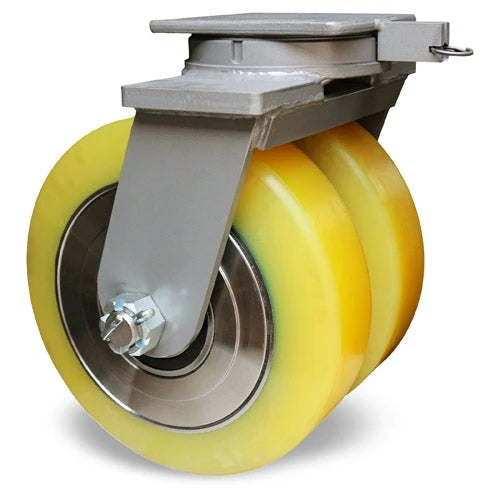
The 16″ x 5″ caster category serves the extreme end of industrial mobility: aerospace tooling, defense assembly fixtures, foundry transfer carts, and heavy equipment positioning where a single caster carries up to 10,000 lb. At this diameter, rolling resistance drops dramatically — a 16″ wheel rolls smoothly over expansion joints, broken concrete, and embedded rail seams that would jam any smaller caster.


Below: the full capacity, tread, bearing, and application matrix for every 16″ x 5″ caster on the page. Pick by floor type and load profile, not by photo — the wheels in this size look similar but the core material drives 80% of life expectancy.
| Tread | Capacity | Best Floor | Bearing | Common Use |
|---|---|---|---|---|
| Polyurethane on Cast Iron | 8,000–10,000 lb | Concrete, epoxy | Tapered roller | Aerospace tooling, heavy assembly |
| Heat-Dissipating Poly | 8,000–10,000 lb | Hot/warm concrete | Tapered roller | Foundry, forge, paint line |
| Forged Steel | 10,000 lb | Steel plate, embedded rail | Tapered roller | Steel mill, shipyard |
| Solid Rubber on Iron | 5,000–7,000 lb | Mixed indoor/outdoor | Roller | Yard transfer, dock-to-dock |
Rolling resistance scales inversely with wheel diameter under heavy load. A 16″ wheel under 10,000 lb generates roughly 40% less rolling resistance than an 8″ wheel at the same load — on a 50 ft push, that’s the difference between a one-person move and a two-person move. The other benefit: contact patch. The 5″ tread width spreads load to about 6 square inches of floor contact per wheel, dropping point pressure low enough to roll across most rated industrial floors without cracking.
Standard ball bearings fail under sustained 10-ton loads. Every 16″ x 5″ caster on the page uses tapered roller bearings — dual-row for the heaviest builds, single-row for the 5,000–7,000 lb tier. Tapered rollers handle both radial load (the weight) and thrust load (cornering force) simultaneously, which is exactly the load profile of an extreme-duty caster.
For aerospace and defense assembly fixtures: polyurethane on cast iron. For foundry and heat-cycling environments: heat-dissipating poly. For steel mill and shipyard: forged steel. For outdoor or mixed-floor transfer carts: solid rubber on iron. Default to polyurethane unless you have a specific reason to deviate — it’s the best balance of load, floor protection, and service life across general industry.