 Specialty Casters
Gate Casters
BBQ Pit & Smoker Casters
Keyed Drive Wheels
Drywall Cart Casters
Skid Wheels & Casters for RVs
Leveling Casters
Shopping Cart Wheels & Casters
Band Equipment Casters & Wheels
Low Profile Casters
Cart Wheels & Casters
Toolbox Caster Sets
Bakery Oven Rack Casters
Kitchen Prep Table Caster Sets
Wire Shelving Casters
Silent Glide Casters
Specialty Casters
Gate Casters
BBQ Pit & Smoker Casters
Keyed Drive Wheels
Drywall Cart Casters
Skid Wheels & Casters for RVs
Leveling Casters
Shopping Cart Wheels & Casters
Band Equipment Casters & Wheels
Low Profile Casters
Cart Wheels & Casters
Toolbox Caster Sets
Bakery Oven Rack Casters
Kitchen Prep Table Caster Sets
Wire Shelving Casters
Silent Glide Casters


This is the tier the math lands on for most real working carts. Run the standard calculation — a 2,000 lb load on a 100 lb cart across four casters with a 1.33 safety factor — and you get 699 lb per caster, right at the top of this band. Service carts, tool carts, utility trolleys, light warehouse equipment, and shop carts almost all calculate into this range.


At this tier the wheel material choice drives most of the outcome. Match the wheel to the floor and the environment; the rig and bearing follow from there.
| Wheel | Typical cap (this tier) | Best floor | Where it fits |
|---|---|---|---|
| Polyurethane on polyolefin | 350–500 lb | Finished concrete, tile | Service & utility carts, light shop |
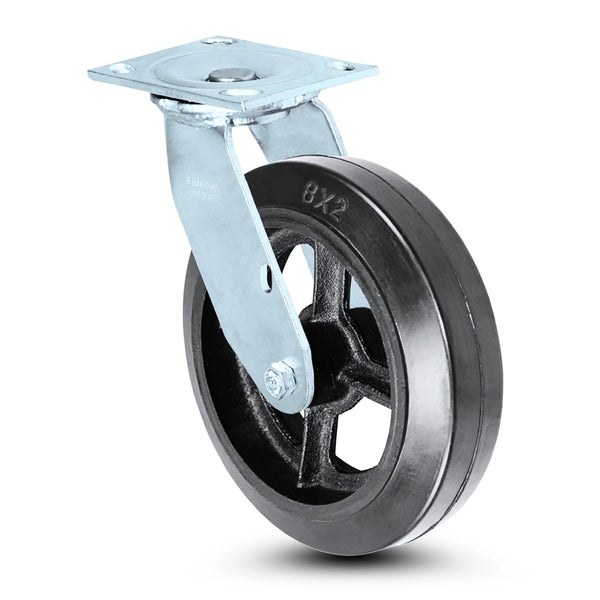
| Polyurethane on aluminum/iron | 500–675 lb | Industrial concrete | Tool carts, light warehouse equipment |
| Phenolic | 500–675 lb | Hard, dry industrial | Oil/solvent areas, low-rolling-resistance routes |
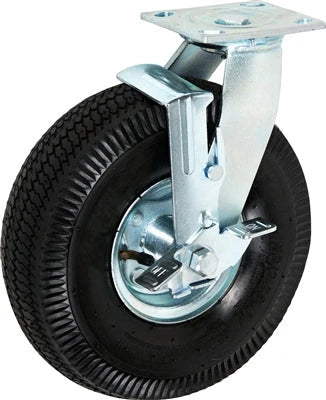
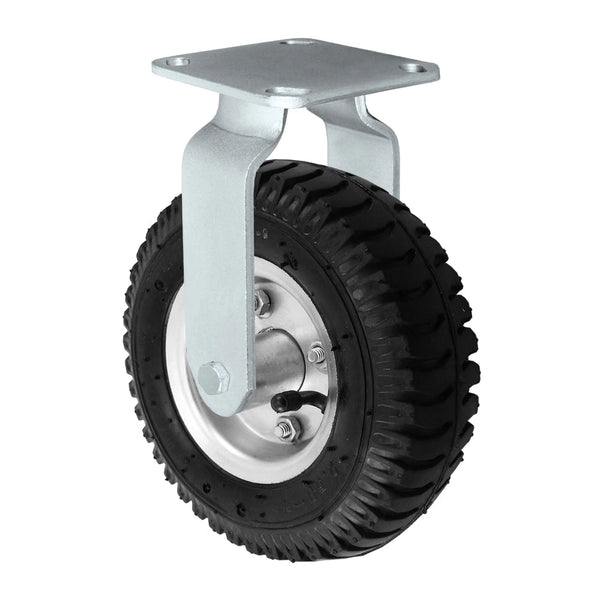
| Pneumatic | 350–500 lb | Outdoor, rough surfaces | Yard carts, outdoor service equipment |
| Thermoplastic rubber | 350–450 lb | Finished floors, quiet zones | Institutional carts, quiet-route equipment |
Total the equipment weight plus the load weight. Multiply by your safety factor — 1.3–1.5× for smooth floors and gentle use, 2× for typical carts and racks, 3–4× if there’s towing, ramps, debris, or impact. Divide by the number of casters. If your equipment has one rigid pair and one swivel pair, size every caster to the same number — load shifts around as the cart turns and you can’t assume even distribution.
Worked example: a 1,400 lb load on a 150 lb cart, four casters, typical use (2× safety factor). (1,400 + 150) × 2 ÷ 4 = 775 lb per caster — that lands one tier up, in the 676-1,250 lb band. Same load at a 1.5× factor lands at 581 lb — inside this tier. The safety factor you pick decides the tier, which is why picking it honestly matters.