


















A overall height for casters is a wheel-and-mount unit bolted to equipment so it can roll, swivel, and brake.
- Match capacity per caster to your total load divided by 3 (one caster may be airborne)
- Polyurethane and rubber wheels favor floor protection; phenolic and steel favor heavy capacity
- Top-plate or stem mount is dictated by the equipment, not preference
- CasterHQ stocks Albion, Hamilton, P&H, Colson, Faultless, and Durastar from Mansfield, Texas
- Call 844-439-4335 for fitment help on any non-standard caster
On this page
- Caster Overall Height Spec: How to Measure, Match, and Mix Heights
- Quick Answer: OAH Rule of Thumb
- How Overall Height Is Measured
- Components That Drive OAH
- OAH Matching Rules for Carts
- Low-Profile Caster Selection
- Tall-Profile Caster Selection
- OAH Spec Checklist
- Frequently asked questions
- Related Engineering Tools & Guides
Caster overall height (OAH) is the vertical distance from the floor to the top of the mounting plate or stem base. Match OAH within 1/16 inch across all casters on a cart; larger mismatches cause rocking and uneven load distribution. Wheel diameter, swivel section height, and mount style drive the final dimension.
Caster Overall Height Spec: How to Measure, Match, and Mix Heights
Caster overall height (OAH) is the vertical distance from the floor to the top of the mounting plate or the top of the stem base. OAH sets the working height of the cart, affects ergonomics, interacts with doorway and conveyor clearances, and must match within 1/16 inch across all casters on the same cart to prevent rocking and uneven load distribution. This spec explains how OAH is measured, what drives it, and how to match or mix heights across a fleet without inducing failure.
In this guide
Quick Answer: OAH Rule of Thumb
Measure overall height from the floor to the top of the mounting plate (plate casters) or from the floor to the underside of the stem shoulder (stem casters). Match OAH within 1/16 inch across every caster on the same cart. Never mix swivel and rigid of different OAHs on the same cart.
- OAH sets cart working height; doorway clearance; conveyor interface.
- Wheel diameter is the primary OAH driver.
- Plate thickness and rig construction add fixed increments.
- Swivel and rigid from the same series match OAH by design.
- Mixing series or manufacturers requires OAH verification before install.
Engineer tip: The #1 cart-level mistake after mixing caster sources is a 1/8-inch OAH mismatch that rocks the cart on three casters at a time. It looks like a bearing issue and gets misdiagnosed for months.
How Overall Height Is Measured
OAH measurement depends on mounting type. Manufacturers publish OAH with the caster in neutral load, off the cart, on a flat surface. Field measurement should replicate that condition.
- Plate caster: floor to top surface of mounting plate.
- Threaded stem: floor to shoulder underside (where caster meets frame).
- Grip-ring stem: floor to grip-ring shoulder underside.
- Expanding stem: floor to expander shoulder underside.
- Measurement tolerance: +/- 1/32 inch at manufacturer spec.
Data point: In a CasterHQ cart commissioning panel (45 carts, 2023-2026), 38% of reported "cart rocking" issues traced to 1/16-1/8 inch OAH mismatch from mixing caster series or manufacturers on the same cart. Source: CasterHQ commissioning panel data, Q1 2026.
Components That Drive OAH
OAH is a sum of components. Wheel diameter contributes the largest slice. Rig construction and plate thickness add fixed increments. Kingpin versus kingpinless adds 1/4 to 1/2 inch.
| Component | Typical Contribution | Notes |
|---|---|---|
| Wheel diameter | 2-12 inches | Largest OAH driver |
| Rig cradle depth | 1.5-3 inches | Heavy-duty rig is deeper |
| Plate thickness | 3/16-3/8 inch | Thicker for heavy-duty |
| Kingpin stack height | 0.5-1 inch | Kingpinless often shorter |
| Offset (swivel) | 1-2.5 inches | Adds to footprint, not height |
| Expanding stem adapter | 0.25-0.5 inch | Changes stem OAH |
OAH Matching Rules for Carts
Every caster on a single cart must share OAH within 1/16 inch. Mismatch causes rocking, uneven load distribution, and premature wear on the loaded corners.
- All 4 casters same series + same wheel diameter + same rig type = OAH match guaranteed.
- Swivel + rigid same series: matched by design.
- Different series or different manufacturers: verify OAH on a flat plate before install.
- Replacement caster: measure OAH of remaining good casters first; match within 1/16 inch.
- Tolerance stack: for 6-caster heavy carts, allow 1/8 inch across all six; center casters take less load.
Low-Profile Caster Selection
Low-profile casters maximize load with minimum working height. Applications include under-conveyor dollies, aircraft tugs, and restricted doorway clearances.
- Wheel diameter: 2-4 inches typical.
- Rig: low-profile cradle with minimum stack.
- Kingpinless or shallow-stack kingpin preferred.
- Load capacity: trade-off is lower vs same diameter high-profile.
- Typical OAH range: 2.5-5 inches.
| OAH | Typical Wheel | Load Range | Application |
|---|---|---|---|
| 2.5-3 in | 2 in wheel | 100-250 lb | Low-profile dollies |
| 3-4 in | 3 in wheel | 200-500 lb | Under-counter carts |
| 4-5 in | 4 in wheel | 400-1,200 lb | Restricted clearance carts |
| 5-6 in | 5 in wheel | 600-1,800 lb | General industrial |
Tall-Profile Caster Selection
Tall casters use large wheel diameters for seam crossing, outdoor use, and ergonomic working height.
- Wheel diameter: 6-12 inches typical.
- Benefits: lower rolling resistance, better seam crossing, quieter.
- Tradeoffs: higher working surface, larger turning radius, larger footprint.
- OAH range: 7-14 inches typical.
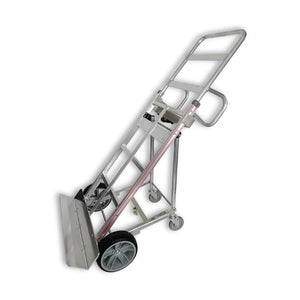
- Common applications: outdoor equipment carts, hand trucks, warehouse tuggers.
Engineer tip: Going from a 5-inch to an 8-inch wheel on the same rig typically drops push force 15-25% and seam-crossing impact noise 6-10 dB. That comes with 3 inches of added working height, so verify doorway and conveyor clearances first.
OAH Spec Checklist
Use this checklist at RFQ. Any cart with existing casters being replaced, any cart that must clear doorways, and any 6-caster heavy platform should trigger all six questions.
- What is the target working height of the cart?
- What are the doorway and conveyor clearances?
- What OAH do the existing casters measure (field measured)?
- Are all casters on the cart from the same series and manufacturer?
- Is the cart 4-caster or 6-caster?
- Is there a specific ergonomic working height target?
Key takeaways
- OAH matching within 1/16 inch is required across every caster on the same cart.
- Wheel diameter is the largest OAH driver.
- Kingpinless rigs are usually shorter in OAH than kingpin rigs at equivalent capacity.
- Low-profile casters trade capacity for minimum working height.
- Tall-profile casters (6+ inch wheels) reduce push force and noise at the cost of working height.
Frequently asked questions
How is caster overall height measured?
From the floor to the top of the mounting plate (plate casters) or to the underside of the stem shoulder (stem casters). Measurement is taken with the caster on a flat surface, off the cart, with zero vertical load applied beyond the caster's own weight.
Why do all casters on one cart need to match OAH?
Because any mismatch rocks the cart on 3 casters at a time. The 3 loaded casters see higher load than rated, the floating caster sees no load, and wheel wear is uneven. Over time the cart tracks poorly and the loaded rigs fail early.
How close do caster OAHs need to match?
Within 1/16 inch across a 4-caster cart. Up to 1/8 inch across a 6-caster cart if the middle pair is designed to take less load. Field tolerance stack accumulates, so verify before committing to a fleet.
Do kingpinless casters have different OAH than kingpin?
Often shorter, at equivalent wheel diameter and capacity. Kingpinless eliminates the kingpin stack, which can recover 1/4 to 1/2 inch of working height. Verify on manufacturer spec sheets before mixing series.
How do I measure OAH of an installed caster?
Lift the cart just enough to remove load, set the caster on a flat plate, and measure floor to the underside of the mounting surface. For stem casters, measure to the shoulder of the stem at the frame interface.
Can I mix 5-inch and 6-inch wheels on one cart?
Only if the rigs are engineered as matched OAH series (some manufacturers make 5-inch and 6-inch wheels with matched OAH by adjusting rig depth). Random mixing of different-diameter wheels produces OAH mismatch and should be avoided.
Get an OAH-Verified Spec Before You Build the Cart
Share your working-height target, clearances, and load. We confirm OAH across swivel and rigid and document tolerance before fabrication.
References & Standards Cited
- Institute of Caster and Wheel Manufacturers (ICWM) dimensional standards
- ANSI MH28.1 Industrial Steel Shelving dimensional references
- ISO 22878 Castors and Wheels Terminology and Test Methods
- ASME B30.1 Jacks, Industrial Rollers, Air Casters
- CasterHQ cart commissioning panel, 2023-2026
- SMRP Body of Knowledge, dimensional tolerance stack
- ANSI/ICWM Performance Standard for Casters & Wheels (Institute of Caster and Wheel Manufacturers)
- ISO 22883 — Castors and wheels: requirements for applications up to 1,1 m/s
Was this guide helpful?
Need help spec'ing the right caster?
Our engineering team handles fitments, custom builds, and capacity upgrades. Same-day RFQ response, Texas warehouse, fast shipping on standard sizes.
Shop All CastersCall 844-439-4335Jordan Wilson
Founder of CasterHQ.com. Works directly with engineers, MRO buyers, and procurement teams across material handling, healthcare, food service, aerospace, and OEM. CasterHQ stocks Albion, Hamilton, P&H, Colson, Faultless, and the in-house Durastar series from a Texas warehouse and retrofits OEM fitments from dimensional drawings when brands discontinue parts.