 Specialty Casters
Gate Casters
BBQ Pit & Smoker Casters
Keyed Drive Wheels
Drywall Cart Casters
Skid Wheels & Casters for RVs
Leveling Casters
Shopping Cart Wheels & Casters
Band Equipment Casters & Wheels
Low Profile Casters
Cart Wheels & Casters
Toolbox Caster Sets
Bakery Oven Rack Casters
Kitchen Prep Table Caster Sets
Wire Shelving Casters
Silent Glide Casters


Wheel = wheel diameter · capacity is per caster.

| Wheel | Single caster | Set of 4 |
|---|---|---|
| 4 x 2 in | 800 lb | 3,200 lb |
| 5 x 2 in | 1,100 lb | 4,000 lb |
| 6 x 2 in | 1,200 lb | 5,000 lb (tool box kit) |
| 8 x 2 in | 1,250 lb | 5,000 lb |
From product titles and fields [S1]. The 4, 5 and 8 in sets pair braked swivels with rigids; the 6 in tool box kit is listed as rigid.
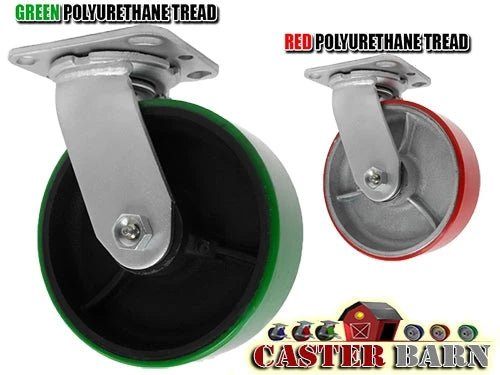
An iron center does not flex under load, so the wheel holds its shape and rolls with little effort. The bonded tread gives a little over cracks and debris and does not chip concrete the way a steel wheel can. Listed temperature ranges top out at 180°F.
A set rating assumes all four casters touch the floor. On an uneven floor one caster can carry far more than a quarter of the load, so leave a margin [S2].
More: polyurethane wheels and 6 x 2 casters.
800 to 1,250 lb per caster, depending on size.
4 x 4-1/2 in.
The 4, 5 and 8 in sets pair braked swivels with rigid casters, rated 3,200 to 5,000 lb per set.