 Specialty Casters
Gate Casters
BBQ Pit & Smoker Casters
Keyed Drive Wheels
Drywall Cart Casters
Skid Wheels & Casters for RVs
Leveling Casters
Shopping Cart Wheels & Casters
Band Equipment Casters & Wheels
Low Profile Casters
Cart Wheels & Casters
Toolbox Caster Sets
Bakery Oven Rack Casters
Kitchen Prep Table Caster Sets
Wire Shelving Casters
Silent Glide Casters
Specialty Casters
Gate Casters
BBQ Pit & Smoker Casters
Keyed Drive Wheels
Drywall Cart Casters
Skid Wheels & Casters for RVs
Leveling Casters
Shopping Cart Wheels & Casters
Band Equipment Casters & Wheels
Low Profile Casters
Cart Wheels & Casters
Toolbox Caster Sets
Bakery Oven Rack Casters
Kitchen Prep Table Caster Sets
Wire Shelving Casters
Silent Glide Casters


Every wheel material has a temperature ceiling. Polyurethane softens at 180°F. Standard polypropylene deforms at 250°F. Nylon flows at 350°F. Cross those thresholds and the wheel stops being a wheel — it becomes a flat spot, a fused puck, or a melted casualty stuck to the rack.
Which heat job are you solving?
High-temp casters are not one-size-fits-all. Pick powder/finishing, bakery oven rack, or BBQ/smoker — then confirm continuous °F and capacity on the product page.
Powder-coat cure, paint booth & flash-off, autoclave/sterilizer, heat-treat adjacent. Measure continuous °F, peak, wet vs dry, load per corner, plate (common finishing: 4″ × 4-1/2″).
Rotating rack ovens and bakery rack carts (hub titles: 475°F). Often 3-1/8″ × 4-1/8″ plate on oven-rack SKUs — measure yours. Start at the bakery oven rack hub for plate fitment, then shop complete casters.
Outdoor pits and smokers need heat plus weather durability and lock-for-cook. Do not spec BBQ outdoor kits as drop-in powder-cure cart casters without measuring duty and mount.
Powder / finishing temp bands (hub language only — VERIFY on PDP)
Powder-cure context (hub, not a SKU rating): common cycles 350–450°F for 20–30 minutes dry heat. Size SKUs to continuous PDP rating with margin. Bakery oven-rack path lives on the bakery oven rack hub and complete oven-rack casters — sibling to this finishing/powder hub, not a replacement for it.
Need a finishing-line or powder-oven quote?
Tell us continuous °F, intermittent peak, load per caster, plate size, and ship ZIP. Qualified accounts can request Net 30 (fee 0 policy) instead of card checkout (about 3–4% processing). Net30 is not unlimited credit — Accounting approval applies.
Request a finishing quote →
or call 844-439-4335 (Mon–Fri 8AM–5PM CST) · info@casterhq.com


High temperature casters use phenolic, epoxy resin, glass-filled nylon, cast iron or steel wheels rated 400°F to 1,300°F continuous, with high-temp grease and zinc or stainless rigs, so a cart can roll through a cure oven, paint line, autoclave or kiln without the wheel softening. CasterHQ stocks what finishing system OEMs, aerospace shops and bakeries reorder: Hamilton spring-loaded phenolic rigids at 1,630 lb, 4″ to 8″ phenolic plate casters at 600 to 1,250 lb, hi-temp glass-filled nylon, epoxy resin, and Inferno forged steel and stainless wheels for 500°F and up. Card checkout, no PO required, same-day shipping from Mansfield, Texas.
Shop by type
 Spring-Loaded Phenolic SPCH
 4x4-1/2 Plate Phenolic
 Hi-Temp Phenolic Wheels
 Hi-Temp Glass-Filled Nylon
 Epoxy Resin Casters
 Inferno Forged Steel to 750°F
 High-Heat Stainless Wheels
 Bakery Oven Rack Casters
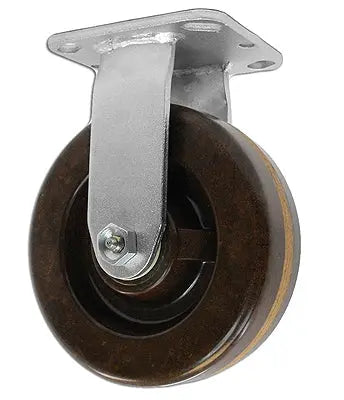
Phenolic wheel casters rated 475°F continuous, on zinc or stainless rigs packed with high-temp grease. Powder coat cure cycles run 350 to 450°F for 20 to 30 minutes in dry heat, so phenolic gives margin where glass-filled nylon (400°F) sits at its edge. Finishing system OEMs on this page buy the Hamilton spring-loaded phenolic rigid, 1,630 lb, 16 to 20 per booth build.
The same buyers take the 8″ x 2″ hi-temp phenolic at 900 lb and the 4″ and 5″ x 2″ phenolic at 600 to 750 lb for cure carts and rack dollies. All share the 4″ x 4-1/2″ plate, so a shop standardizes one bolt pattern across the line.
Glass-filled nylon for wet-cycle heat and phenolic for dry bake-down. A paint booth cart sees solvent, overspray and a 160 to 250°F flash-off or bake, so the wheel needs chemical resistance first and heat second: glass-filled nylon to 400°F resists solvents and moisture, phenolic to 475°F is the pick when the same cart also enters the cure oven.
Overspray builds up on the tread and in the raceway, so spec a sealed raceway and plan to scrape wheels at each color change. Polyurethane softens at 180°F and holds overspray permanently; keep it off the line.
Stainless steel rigging with phenolic or epoxy resin wheels. An autoclave cart cycles to about 270°F under 15 to 20 psi of saturated steam, so the rig has to shrug off moisture and the wheel has to hold its dimensions wet. Phenolic and epoxy resin do; glass-filled nylon slowly absorbs steam and loses accuracy over months of cycles.
Grease matters as much as the wheel. Standard lithium grease liquefies at 300°F and runs out of the bearing; spec Krytox or Mobilith SHC 460 packed bearings on anything that runs above 350°F.
| Wheel Size | Phenolic (TP / dry heat) | Glass-Filled Nylon (NP / moist heat) | Application |
|---|---|---|---|
| 4″ x 1-1/2″ | 300 lb @ 475°F | 300 lb @ 475°F | Small paint booth, cure carts |
| 4″ x 2″ | 800 lb @ 475°F | 700 lb @ 475°F | Medium paint booth, oven-adjacent transport |
| 5″ x 2″ | 1,000 lb @ 475°F | 900 lb @ 475°F | Standard HD paint booth, powder coat cure |
| 6″ x 2″ | 1,200 lb @ 475°F | 1,100 lb @ 475°F | Heavy production ovens, foundry-adjacent |
| 8″ x 2″ | 1,250 lb @ 475°F | 1,250 lb @ 475°F | Heaviest HD high-temp applications |
Powder coating cure ovens, dry-cycle bakery production, paint booth bake-down, dry foundry-adjacent transport. Phenolic absorbs moisture if exposed to steam or wash cycles — the wheel swells and dimensions shift, throwing wheel-to-floor clearance off.
Smokehouse rack carts, wet-cycle bakery proofers, autoclaves, sterilizer carts that cycle through steam. The 30% glass-fiber reinforcement gives the nylon dimensional stability through wet-dry transitions. Same temperature rating as phenolic.
Step over to specialty high-temp materials (epoxy resin, ceramic composite) — see Inferno forged steel casters for the broader catalog above 575°F.
Standard bakery rack casters use glass-filled nylon wheels with high-temperature lithium grease and zinc-plated rigging. The rack moves between proof box (~85°F), oven (~400°F), and ambient kitchen multiple times per shift. The wheel sees the temperature cycle, not sustained peak. Phenolic is the upgrade for higher-temp commercial bakery and pizza oven racks running 425-475°F continuous.
Autoclave carts face dual challenges: temperature and saturated steam. The wheel and rigging both have to handle the heat and the moisture without rust or material change. Stainless steel rigging with phenolic or epoxy resin wheels is the standard build. Glass-filled nylon will work for short-cycle exposure but slowly absorbs steam and loses dimensional stability over time. Most hospital and pharma autoclaves spec phenolic for sustained service.
Powder coating cure ovens run hot and dry. Phenolic wheels are the standard at this temperature. Glass-filled nylon at the 400-450°F end of the range will work but trends toward the edge of its rating — phenolic gives margin. Cast iron is the heavier-duty alternative for racks that carry significant load (engine castings, large fabrications) where the polymer wheels would exceed their load rating.
Above ~500°F, all polymer and resin wheels stop working. Cast iron is the entry point. For steel hardening lines, ceramic kilns, and high-temp brazing furnaces, steel wheels with high-temp graphite-packed bearings or oil-lubricated sleeve bearings are required. Sealed ball or roller bearings cannot survive sustained 800°F+ operation regardless of the seal compound.
Commercial kitchen equipment that sees periodic heat exposure during cleaning, transport into hot environments, or holding warmer duty. Standard polyurethane survives 180°F but degrades faster than glass-filled nylon at sustained 250°F+. The right call here is glass-filled nylon with stainless steel rigging for NSF kitchen compatibility.
Saturated steam (autoclave, dishwasher rack, sterilizer) demands stainless rigging and a wheel that won’t absorb water at temperature — phenolic or epoxy resin. Glass-filled nylon technically rates 400°F but absorbs steam over time and loses dimensional accuracy. Dry heat (oven rack, powder coat, kiln) is more forgiving on wheel material; glass-filled nylon and phenolic both work in 300-450°F dry-heat range. Always declare dry vs. wet when specifying.
When these casters are NOT the right choice
Updated: September 13, 2026 · Last reviewed by Jordan Wilson · Specs verified September 2026