 Specialty Casters
Gate Casters
BBQ Pit & Smoker Casters
Keyed Drive Wheels
Drywall Cart Casters
Skid Wheels & Casters for RVs
Leveling Casters
Shopping Cart Wheels & Casters
Band Equipment Casters & Wheels
Low Profile Casters
Cart Wheels & Casters
Toolbox Caster Sets
Bakery & High Temperature Casters
Kitchen Prep Table Caster Sets
Wire Shelving Casters
Silent Glide Casters
Specialty Casters
Gate Casters
BBQ Pit & Smoker Casters
Keyed Drive Wheels
Drywall Cart Casters
Skid Wheels & Casters for RVs
Leveling Casters
Shopping Cart Wheels & Casters
Band Equipment Casters & Wheels
Low Profile Casters
Cart Wheels & Casters
Toolbox Caster Sets
Bakery & High Temperature Casters
Kitchen Prep Table Caster Sets
Wire Shelving Casters
Silent Glide Casters


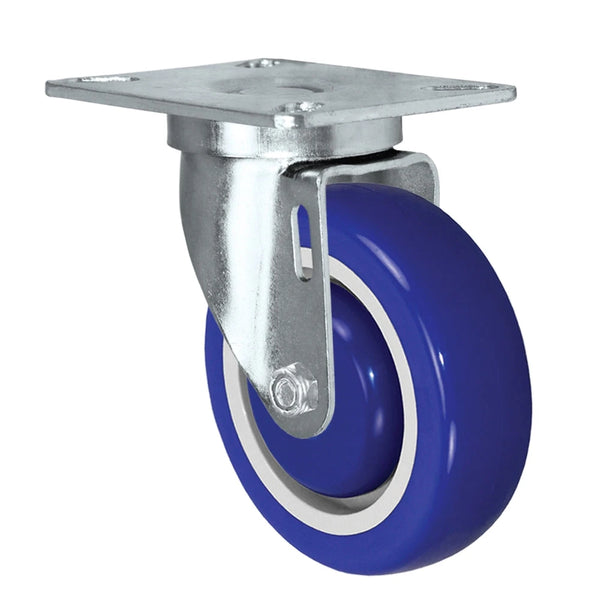
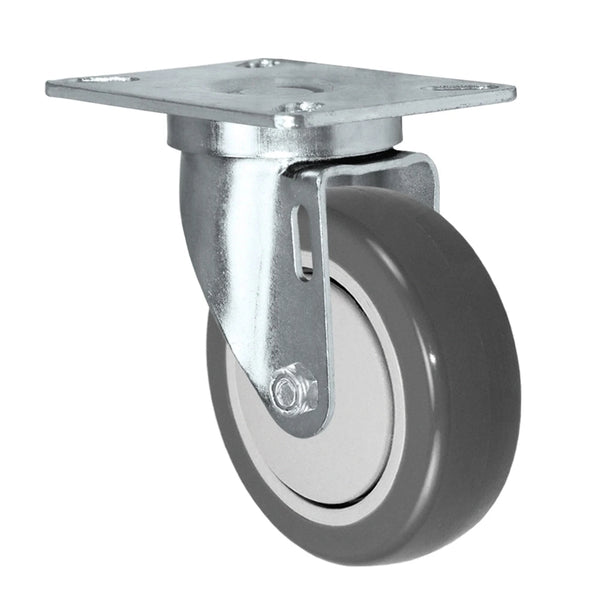
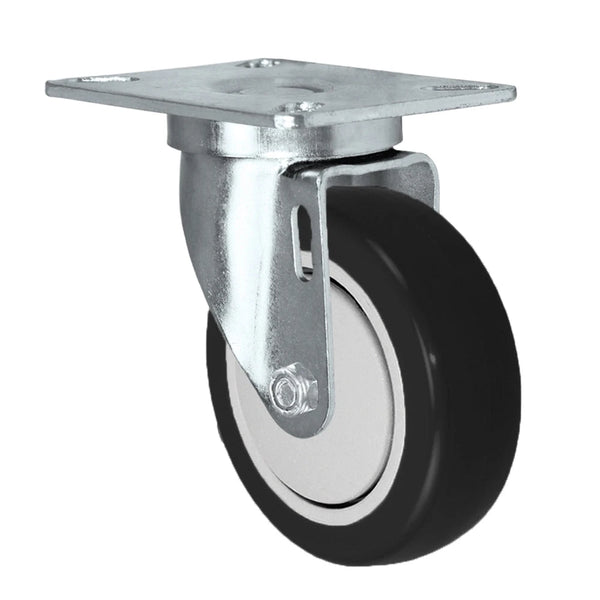
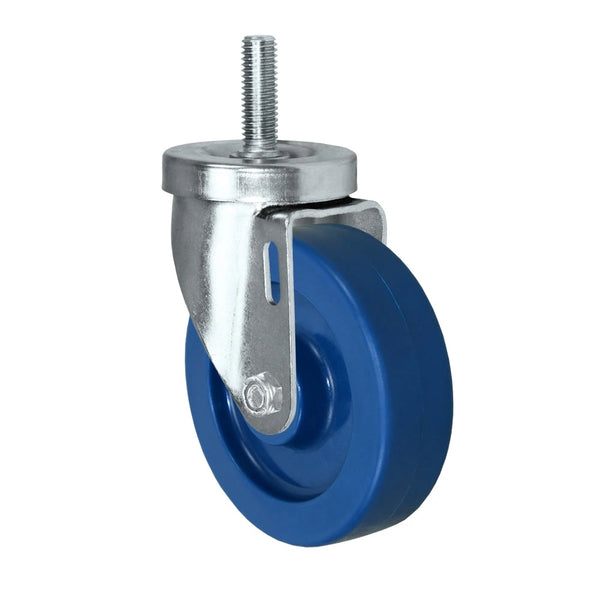
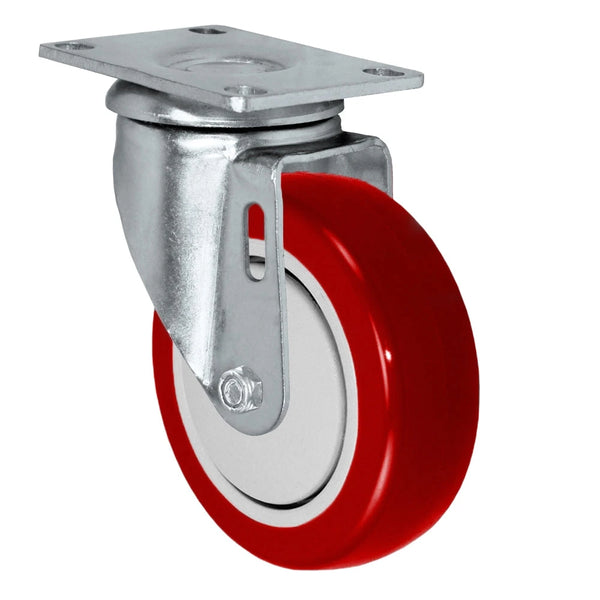
Polyurethane swivel casters provide 360° rotation around the caster's vertical axis — essential for maneuvering in tight spaces. CasterHQ stocks 722 polyurethane swivel configurations across plate and stem mounts, from 75 lb (light institutional) to 2,000 lb (heavy industrial). Polyurethane swivels are typically paired 2-and-2 with rigid casters for stable tracking under push.
For carts pushed more than 30 feet regularly, use 2-rigid 2-swivel — tracks straight under push, faster for operators, safer on ramps. All-swivel offers maximum maneuverability in tight spaces (medical carts, office chairs) but tends to drift sideways under push force. Tow lines and warehouse carts always use 2-and-2.
Swivel casters typically carry 15–25% LESS load than equivalent rigid casters of the same wheel size, because the swivel mechanism adds a ball-bearing race in the load path. A 1,000 lb rigid would be a 750–850 lb swivel. Spec swivels at the front of the cart (steering end) and rigids at the rear (load-bearing end).
Yes — the swivel construction is the foundation for ALL caster brakes (side-lock, top-lock, total-lock). Total-lock requires swivel because it locks the swivel race AND the wheel; rigid casters cannot have total-lock since there's nothing to lock. Side-lock available on both swivel and rigid.
Why are swivel casters more expensive than rigid? The swivel race adds a precision ball bearing assembly above the wheel — more parts, tighter tolerances.
How much does swivel rotation force matter? A lot for high-frequency push carts. Precision ball swivel races reduce push-to-turn force 30-40% vs plain bearings.
Can I get a 2,000 lb swivel? Yes — heavy-duty kingpinless swivel casters reach 2,000 lb in polyurethane. For higher loads, switch to forged steel.
What's a kingpinless swivel? A swivel race design without the central kingpin bolt — eliminates the #1 caster failure mode in heavy industrial use.
Stainless steel swivel? Full 304 stainless across all swivel configurations for clean room and food service.
Divide total cart weight by 3 (not 4) because uneven floors cause one caster to temporarily lift, redistributing load to the remaining three. Multiply by 1.25 for dynamic impact (rolling onto floor seams, dock plates, thresholds). Example: a 1,500 lb cart needs casters rated ≥ 625 lb each (1,500 ÷ 3 × 1.25).
| Class | Wheel Dia. | Load/Caster | Bearing | Best Use |
|---|---|---|---|---|
| Light Institutional | 2–3″ | 75–300 lb | Plain bushing | Office, retail, medical |
| Medium Duty Most Popular | 4–5″ | 300–900 lb | Precision ball | Warehouse, shop |
| Heavy Duty | 6–8″ | 1,200–2,000 lb | Tapered roller | Industrial, tow lines |
| Kingpinless | 6–8″ | 1,500–2,000 lb | Sealed roller | No-kingpin failure mode |
Spec'd 240 cart conversions to CasterHQ's 5-inch polyurethane swivel + rigid 2-and-2 layout. Operator push-effort surveys showed 32% improvement in fatigue scoring. Their engineer matched the swivel race to our cart weight without us needing to send specs — just told them what we move and where.
Application engineers on staff · ISO-certified facility · 50,000+ businesses served · 100+ combined years in caster design